
A Bridge on Economic Issues between China and the World



 Facebook
  Twitter
  Instagram
 WeChat
  Email
Email 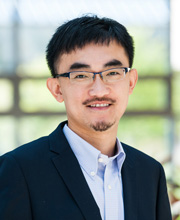
Zhiguo He
Zhiguo He
Professor Zhiguo He is the James Irvin Miller Professor of Finance at Stanford Graduate School of Business. He is a financial economist whose expertise covers financial markets, financial institutions, and macroeconomics broadly. He is also conducting academic research on Chinese financial markets and recent advances in blockchain technology, alongside teaching MBA electives on China’s Economy and Fintech. Before joining Stanford GSB, he was on the faculty of Chicago Booth from 2008 to 2023, where he led Becker Friedman Institute China at University of Chicago from 2020 to 2023.
His research has been published in leading academic journals in finance and economics. After serving as associate editors for several leading academic journals, He served as the guest editor of the Review of Finance “Special Issue on China” and currently serves as the editor of the Review of Asset Pricing Studies.
Professor He received his bachelor and master degrees from the School of Economics and Management at Tsinghua University before receiving his PhD from the Kellogg School of Management at Northwestern University in 2008. He has been named a 2014 Alfred P. Sloan Research Fellow, and has won numerous awards for his outstanding scholastic record, including the Lehman Brothers Fellowship for Research Excellence in Finance, the Swiss Finance Institute Outstanding Paper Award, the Smith-Breeden First Prize, and the Brattle Group First Prize. Before his academic career at Chicago Booth, he worked as a stock analyst at the China International Capital Corporation in Beijing in 2001 and visited the Bendheim Center for Finance at Princeton University as a post-doctoral fellow in 2008.
In Autumn 2015, Professor He was the Dean’s distinguished visiting scholar at Stanford Graduate School of Business, and, in winter 2020, he was a visiting professor of finance at Yale University, School of Management. In January 2020, he testified at U.S.-China Economic and Security Review Commission (USCC) Hearing on “China’s Quest for Capital: Motivations, Methods, and Implications.”
Articles
When Cash Unlocks Mobility: China’s Shantytown Renovation Program and the Housing Markets
Jul 08, 2026Homemade Foreign Trading
Jul 26, 2023Underestimated Role of Banks in China’s Bond Market
Jul 17, 2019Leverage-Induced Fire Sales and Stock Market Crashes
Dec 03, 2018
Zhiguo He
Most Popular
- VoxChina Covid-19 Forum (Second Edition): China’s Post-Lockdown Economic Recovery VoxChina, Apr 18, 2020
- China’s Great Housing Boom Kaiji Chen, Yi Wen, Oct 11, 2017
- China’s Joint Venture Policy and the International Transfer of Technology Kun Jiang, Wolfgang Keller, Larry D. Qiu, William Ridley, Feb 06, 2019
- The Dark Side of the Chinese Fiscal Stimulus: Evidence from Local Government Debt Yi Huang, Marco Pagano, Ugo Panizza, Jun 28, 2017
- Wealth Redistribution in the Chinese Stock Market: the Role of Bubbles and Crashes Li An, Jiangze Bian, Dong Lou, Donghui Shi, Jul 01, 2020
- Evaluating Risk across Chinese Housing Markets Yongheng Deng, Joseph Gyourko, Jing Wu, Aug 02, 2017
- Daily Price Limits and the Magnet Effect Ting Chen, Zhenyu Gao, Jibao He, Wenxi Jiang, Wei Xiong, Oct 25, 2017
- What Is Special about China’s Housing Boom? Edward L. Glaeser, Wei Huang, Yueran Ma, Andrei Shleifer, Jun 20, 2017
- Privatization and Productivity in China Yuyu Chen, Mitsuru Igami, Masayuki Sawada, Mo Xiao, Jan 31, 2018
- How did China Move Up the Global Value Chains? Hiau Looi Kee, Heiwai Tang, Aug 30, 2017