
A Bridge on Economic Issues between China and the World



 Facebook
  Twitter
  Instagram
 WeChat
  Email
Email Beyond the Heat: Power Rationing Matters More When Extreme Temperature Strikes
As climate change intensifies, extreme heatwaves increasingly trigger severe power shortages in emerging economies like China. Governments are forced to implement power rationing, making difficult trade-offs between satisfying residential electricity demand and sustaining industrial production. Evidence shows that administrative power rationing during these crises inflicts greater economic damage on firm performance than the physical heat itself.
As heatwaves shatter records across the globe, discussions often focus on the direct physical and health impacts of rising temperatures. A growing body of research shows that higher temperatures reduce labor productivity and harm human health (Agarwal et al. 2021, Somanathan et al. 2021). World Bank research involving over 160,000 firms globally indicates that even a slight 0.5°C deviation from historical temperature norms can trigger a 12% collapse in firm revenues in low- and middle-income economies (Berg et al. 2025). However, in many emerging economies like China, the greater threat to industry may not be the heat itself, but the energy crises it triggers. When electricity grids are pushed to their limits, the “invisible hand” of the market is often replaced by the “visible hand” of administrative power rationing. Our recent study reveals that during heatwaves, how electricity is allocated across firms and households matters more for economic resilience than the mercury in the thermometer.
The Sichuan warning
The memories of the 2022 power crunch in Sichuan, China, remain vivid. A record-breaking combination of extreme heatwaves and severe drought struck the province, which relies heavily on hydropower. To prioritize residential electricity, the government suspended industrial operations in 19 of 21 cities for about two weeks. Sichuan is a vital hub for China’s “West-to-East Power Transmission” project and a global manufacturing base for giants like Apple, Foxconn, and Intel. Without effective countermeasures, such localized heat shocks can quickly escalate into broader disruptions across power grids and supply chains. As climate change intensifies, the strain on the power supply triggered by extreme heat may become part of the new normal.
Key findings: Power rationing bites harder than heat
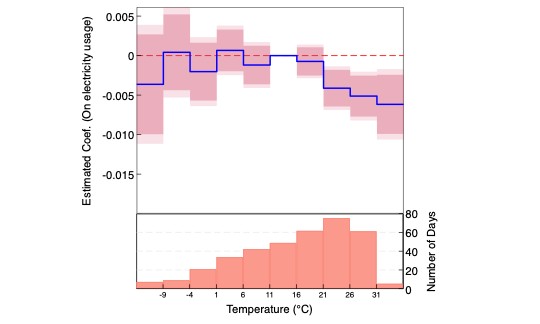
By combining comprehensive panel data on Chinese firms with high-resolution meteorological data, we document a surprising pattern: While electricity demand typically surges during heatwaves, actual firm-level consumption declines—a phenomenon driven primarily by power rationing (Hao et al. 2025). For each additional day with an average temperature above 31°C (compared to a mild 11–16°C baseline), a firm’s electricity usage falls by 0.72%, after accounting for other factors. There exist supply constraints: our empirical strategy confirms that Chinese firms face severe power supply constraints during extreme temperatures. Although high temperatures do lead to adjustments in production factors and lower labor productivity, the impact of power rationing on firm performance is even more devastating. Figure 1 illustrates the relationship between high temperature exposure and firms’ electricity usage.
Figure 1. The impact of high temperature exposure on firms’ electricity usage
The structural tension in China’s energy governance
These findings point to a fundamental structural tension within China’s energy system. Historically, China has relied on a command and control model where electricity is allocated via administrative quotas rather than price signals. During extreme heat, this lack of market-based flexibility forces local governments into a binary choice: keeping air conditioners on for households or keeping machines running for factories.
Because electricity prices for industry and residents are often sticky—remaining fixed even as the cost of marginal supply skyrockets—the market cannot clear through price adjustments. Consequently, the burden of adjustment falls entirely on the visible hand of rationing. This rigid priority system effectively creates an insurance policy for residential comfort, but the premium is paid by industrial firms in the form of lost productivity and disrupted supply chains. Our theoretical framework evaluates this trade-off by comparing households’ marginal willingness to pay to avoid power interruptions against the marginal output of industrial usage. During extreme heat, the marginal benefit of keeping households cool dramatically outweighs the value of industrial output, making residential prioritization a welfare-maximizing emergency response under China's fixed-price regime.
Policy implications: Toward a smarter, more flexible grid
Our findings provide a strong economic rationale for accelerating China’s reforms to its electricity spot market. When a heatwave strikes, the lack of a functional price signal forces the government to rely on administrative load shedding to balance the grid. However, as our study documents, this rationing often hits high-productivity firms just as hard as low-efficiency ones, leading to significant aggregate welfare losses.
By transitioning to a full-scale spot market, China can replace these blunt mandates with scarcity pricing. In such a system, high-value-added firms could choose to pay a premium to maintain production, while more flexible users could be compensated for reducing their load through demand-side response. A market-driven grid would allow prices to reflect real-time supply and demand, enabling more efficient allocation during peak periods. It is therefore essential to enhance market flexibility.
Conclusion: Institutions matter in a warming world
Ultimately, we demonstrate that the economic toll of climate change is filtered through the quality of our institutions. While the 2022 crisis in Sichuan offered a snapshot of these tensions, our long-term evidence across China’s industrial landscape reveals a more systemic vulnerability: The greatest threat to industrial performance in a warming world is not the heat itself, but a rigid energy governance system that lacks market-based flexibility.
Navigating the transition toward climate resilience requires moving beyond an emergency firefighting mindset. The trade-off between short-term residential stability and long-term industrial growth cannot be resolved through administrative mandates alone. Instead, it requires a profound institutional shift that replaces blunt rationing with the precision of market-clearing prices. In the global race to adapt to a changing climate, the most powerful tool for economic resilience may not be more air conditioners or coal-fired power plants, but a smarter, more flexible, and market-driven power grid.
References
Agarwal, Sumit, Yu Qin, Luwen Shi, Guoxu Wei, and Hongjia Zhu. 2021. “Impact of Temperature on Morbidity: New Evidence from China.” Journal of Environmental Economics and Management 109, 102495. https://doi.org/10.1016/j.jeem.2021.102495.
Berg, Claudia N., Luca Bettarelli, Davide Furceri, Michael Ganslmeier, Arti Grover, Megan Elizabeth Lang, and Marc Tobias Schiffbauer. 2025. “Firm-Level Climate Change Adaptation: Micro-Evidence from 134 Nations.” World Bank Policy Research Working Paper No. WPS11081. http://documents.worldbank.org/curated/en/099629503052522688.
Hao, Xinya, Yangying Huang, and Lin Zhang. 2025. “High Temperature, Power Rationing, and Firm Performance.” Journal of Development Economics 176, 103541. https://doi.org/10.1016/j.jdeveco.2025.103541.
Somanathan, E., Rohini Somanathan, Anant Sudarshan, and Meenu Tewari. 2021. “The Impact of Temperature on Productivity and Labor Supply: Evidence from Indian Manufacturing.” Journal of Political Economy 129 (6): 1797–27. https://doi.org/10.1086/713733.

Latest
Most Popular
- VoxChina Covid-19 Forum (Second Edition): China’s Post-Lockdown Economic Recovery VoxChina, Apr 18, 2020
- China’s Great Housing Boom Kaiji Chen, Yi Wen, Oct 11, 2017
- China’s Joint Venture Policy and the International Transfer of Technology Kun Jiang, Wolfgang Keller, Larry D. Qiu, William Ridley, Feb 06, 2019
- The Dark Side of the Chinese Fiscal Stimulus: Evidence from Local Government Debt Yi Huang, Marco Pagano, Ugo Panizza, Jun 28, 2017
- Wealth Redistribution in the Chinese Stock Market: the Role of Bubbles and Crashes Li An, Jiangze Bian, Dong Lou, Donghui Shi, Jul 01, 2020
- Evaluating Risk across Chinese Housing Markets Yongheng Deng, Joseph Gyourko, Jing Wu, Aug 02, 2017
- Daily Price Limits and the Magnet Effect Ting Chen, Zhenyu Gao, Jibao He, Wenxi Jiang, Wei Xiong, Oct 25, 2017
- What Is Special about China’s Housing Boom? Edward L. Glaeser, Wei Huang, Yueran Ma, Andrei Shleifer, Jun 20, 2017
- Privatization and Productivity in China Yuyu Chen, Mitsuru Igami, Masayuki Sawada, Mo Xiao, Jan 31, 2018
- How did China Move Up the Global Value Chains? Hiau Looi Kee, Heiwai Tang, Aug 30, 2017