
A Bridge on Economic Issues between China and the World



 Facebook
  Twitter
  Instagram
 WeChat
  Email
Email AI Patents in the United States and China: Measurement, Organization, and Knowledge Flows
Debates about artificial intelligence (AI) often ask whether the United States and China are technologically decoupling. Using a new high-precision measure of AI patents, we show a more nuanced picture. AI innovation in the two countries is converging in scale and technological direction, but remains highly asymmetric in institutional organization, geographic diffusion, and cross-border knowledge dependence. Chinese AI patents rely heavily on US frontier technologies, while US reliance on Chinese innovation is more limited.
Artificial intelligence (AI) has become a central arena of technological competition between the United States and China. Recent policy debates often frame this competition in terms of rivalry, decoupling, and technological self-sufficiency. A growing body of academic literature examines whether cross-border technological integration between the two countries is weakening as geopolitical tensions rise (e.g. Han et al. 2024).
At the same time, a long-standing concern is whether China’s rapid patent growth reflects genuine technological progress or policy-driven expansion of lower-value innovation (Dang and Motohashi 2015, Fang et al. 2018). Recent work comparing patent quality across countries further suggests systematic differences in the innovations between China and the US (Fang et al. 2021). These debates highlight a fundamental challenge: how should we measure and compare innovation in emerging technologies such as AI?
Despite its importance, empirical evidence remains limited, in part because AI is not a single patent category but spans multiple technological domains. Existing classification approaches suffer from limited precision and recall (Giczy et al. 2021, Pairolero et al. 2025), making it difficult to assess both the scale and structure of AI innovation.
Measuring AI innovation
We address the measurement of AI patents by building on the United State Patent and Trademark Office (USPTO) Artificial Intelligence Patent Dataset (AIPD). Using its labelled patents as training data, we fine-tune a transformer-based language model to recognize how AI-related inventions are described in patent texts. The model then identifies AI patents across the full dataset with substantially fewer false positives and false negatives, and assigns them to core AI subfields, including machine learning, natural language processing, speech, vision, planning, knowledge processing, and hardware.
Compared with the original AIPD classification, this approach significantly improves accuracy, achieving about 97% precision and 91% recall. This matters because classification error in existing measures can bias estimates of both the scale and the composition of AI innovation, particularly in cross-country comparisons.
Validation exercises further show that the resulting classification captures patents that are more closely connected to the AI knowledge frontier, both in terms of citation patterns and textual similarity. Importantly, the approach generalizes well across countries, allowing consistent comparison between the US and China.
Convergence in scale and technological direction
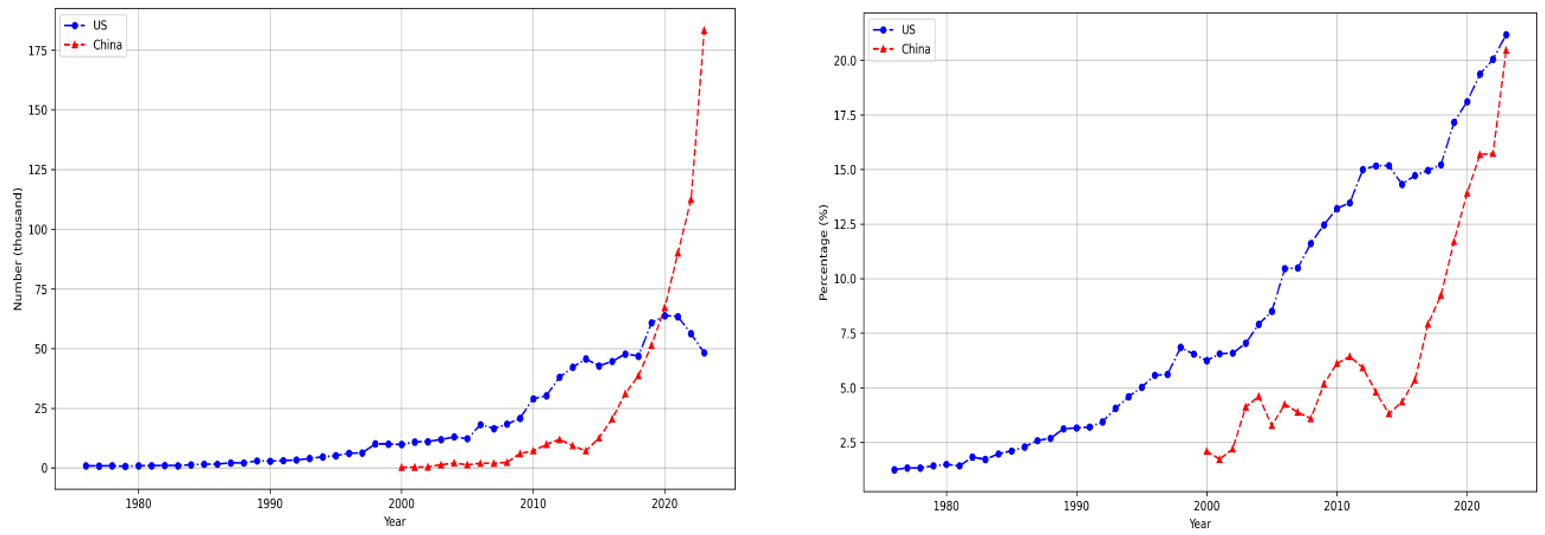
Using this measure, we document a rapid expansion of AI patenting in both countries. China has overtaken the US in annual AI patent counts in recent years. However, when measured as a share of total patenting activity, the two countries exhibit similar levels of AI intensity.
Figure 1 presents the number and percentage of AI patents each year, granted by the USPTO and the China National Intellectual Property Administration (CNIPA). We define AI patents as those assigned by our model to at least one of the seven core AI subcategories: machine learning (ML), natural language processing (NLP), speech, vision, planning, knowledge processing (KR), and hardware. The left panel shows the number of AI patents granted by the USPTO and the CNIPA each year, and the right panel reports the corresponding percentage of AI patents relative to all patents granted by each office.
Figure 1. Comparing AI patents: USPTO vs. CNIPA
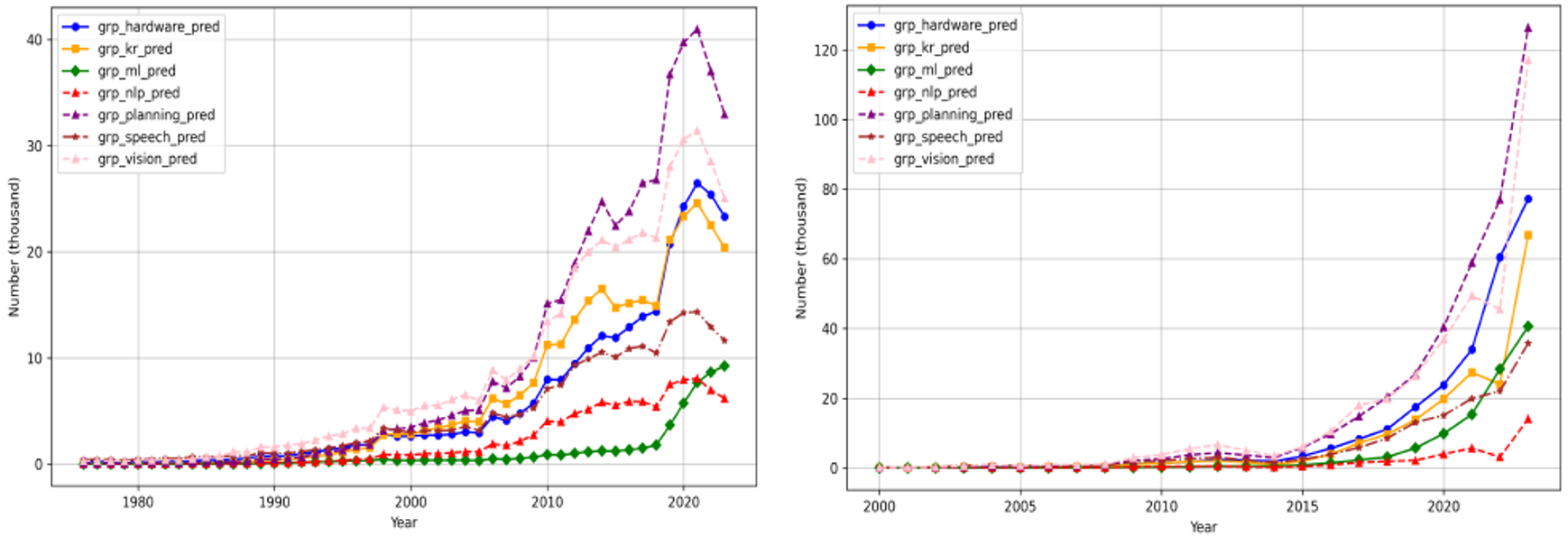
The technological composition of AI innovation is also broadly similar. In both countries, patenting activity is concentrated in core subfields such as planning, vision, and hardware. This suggests convergence not only in the scale of AI innovation but also in its technological direction. At the same time, differences remain at the frontier. The US expanded earlier in natural language processing, while China has experienced rapid catch-up in recent years.
Figure 2 presents the number of AI patents granted by the USPTO and the CNIPA each year in each of seven main AI subcategories: machine learning (ML), natural language processing (NLP), speech, vision, planning, knowledge processing (KR), and hardware. The left panel reports the number of AI patents in each subcategory granted by the USPTO each year, and the right panel reports those for the CNIPA. All counts are reported in thousands.
Figure 2. AI patents by subcategory: USPTO vs. CNIPA
Divergent organizational structures of innovation
Despite convergence in output, the organization of AI innovation differs substantially across the two countries. In the US, AI patenting is dominated by large private firms such as IBM, Microsoft, and Google. Innovation activity is concentrated in established technology hubs and remains relatively stable over time. In contrast, China exhibits a more diverse institutional structure. Universities and state-owned enterprises play a prominent role alongside private firms such as Tencent, Huawei, and Alibaba. AI innovation is also more geographically diffuse, spreading beyond initial hubs to a broader set of cities.
These patterns suggest a fundamental difference: convergence in technological outcomes but divergence in the institutional and spatial organization of innovation.
The economic value of AI innovation
A common concern is that rapid patent growth, particularly in China, may reflect low-quality innovation. We evaluate the economic value of AI innovation using stock market reactions around patent grants, following the methodology of Kogan et al. (2017). The results show that AI patents are associated with a significant valuation premium relative to non-AI patents in both countries.
This premium is especially strong in data- and software-intensive areas such as machine learning and natural language processing. Importantly, the presence of a similar premium in China suggests that AI patents capture economically meaningful innovation, even when produced by non-market institutions.
Cross-border knowledge flows: Integration but with asymmetry
A central question is whether the US and China are technologically decoupling. The evidence suggests continued integration rather than separation. Cross-border citation patterns show increasing knowledge flows between the two countries over time. However, these flows are asymmetric. Chinese AI patents rely heavily on US frontier technologies, while US reliance on Chinese innovation is more limited. This pattern points to a form of integration without symmetry: the global AI innovation system remains interconnected, but dependence is uneven.
To conclude, the global AI landscape cannot be reduced to a simple narrative of competition or decoupling. The US and China are converging in the scale and direction of AI innovation yet diverging in how innovation is organized and diffused. At the same time, knowledge flows between the two countries remain strong, indicating a deeply interconnected global system.
For policymakers, this creates a real trade-off. Strengthening domestic technological capacity often means reducing reliance on foreign inputs, but AI innovation still depends heavily on shared global knowledge. Restrictions on collaboration, talent flows, or access to key technologies may slow diffusion, but they can also dampen the pace of innovation more broadly.
These effects are also unlikely to be even across countries. China’s AI innovation remains more closely tied to US frontier technologies, suggesting greater exposure to tighter restrictions, while the US may be less affected in core areas. Taken together, this points less to a clean decoupling and more to a situation where competition and interdependence continue to coexist.
Hanming Fang, University of Pennsylvania; Xian Gu, Durham University; Hanyin Yan, Tsinghua University; Wu Zhu, Tsinghua University
References
Dang, Jianwei, and Kazuyuki Motohashi. 2015. “Patent Statistics: A Good Indicator for Innovation in China? Patent Subsidy Program Impacts on Patent Quality.” China Economic Review, 35: 137–55. https://doi.org/10.1016/j.chieco.2015.03.012.
Fang, Hanming, Zheng (Michael) Song, Hanyi Tao, and Yiran Zhang. 2021. “An Anatomy of Patent Quality: China vs US.” Working paper. https://cicm.pbcsf.tsinghua.edu.cn/cn2021/pdf/1621585106754701.pdf
Fang, Lily, Josh Lerner, Chaopeng Wu, and Qi Zhang. 2018. “Corruption, Government Subsidies, and Innovation: Evidence from China.” National Bureau of Economic Research Working Paper No. 25098. https://www.nber.org/system/files/working_papers/w25098/w25098.pdf.
Giczy, Alexander V., Nicholas A. Pairolero, and Andrew A. Toole. 2021. “Identifying Artificial Intelligence (AI) Invention: A Novel AI Patent Dataset.” Journal of Technology Transfer 47 (2): 476–505. https://doi.org/10.1007/s10961-021-09900-2.
Han, Pengfei, Wei Jiang, and Danqing Mei. 2024. “Mapping US–China Technology Decoupling: Policies, Innovation, and Firm Performance.” Management Science 70 (12): 8386–8413. https://doi.org/10.1287/mnsc.2022.02057.
Kogan, Leonid, Dimitris Papanikolaou, Amit Seru, and Noah Stoffman. 2017. “Technological Innovation, Resource Allocation, and Growth.” Quarterly Journal of Economics 132 (2): 665–712. https://doi.org/10.1093/qje/qjw040.
Pairolero, Nicholas A., Alexander V. Giczy, Gerard Torres, Tisa Islam Erana, Mark A. Finlayson, and Andrew A. Toole. 2025. “The Artificial Intelligence Patent Dataset (AIPD) 2023 Update.” Journal of Technology Transfer 50: 2587–2610. https://doi.org/10.1007/s10961-025-10189-8.

Latest
Most Popular
- VoxChina Covid-19 Forum (Second Edition): China’s Post-Lockdown Economic Recovery VoxChina, Apr 18, 2020
- China’s Great Housing Boom Kaiji Chen, Yi Wen, Oct 11, 2017
- China’s Joint Venture Policy and the International Transfer of Technology Kun Jiang, Wolfgang Keller, Larry D. Qiu, William Ridley, Feb 06, 2019
- The Dark Side of the Chinese Fiscal Stimulus: Evidence from Local Government Debt Yi Huang, Marco Pagano, Ugo Panizza, Jun 28, 2017
- Wealth Redistribution in the Chinese Stock Market: the Role of Bubbles and Crashes Li An, Jiangze Bian, Dong Lou, Donghui Shi, Jul 01, 2020
- Evaluating Risk across Chinese Housing Markets Yongheng Deng, Joseph Gyourko, Jing Wu, Aug 02, 2017
- Daily Price Limits and the Magnet Effect Ting Chen, Zhenyu Gao, Jibao He, Wenxi Jiang, Wei Xiong, Oct 25, 2017
- What Is Special about China’s Housing Boom? Edward L. Glaeser, Wei Huang, Yueran Ma, Andrei Shleifer, Jun 20, 2017
- Privatization and Productivity in China Yuyu Chen, Mitsuru Igami, Masayuki Sawada, Mo Xiao, Jan 31, 2018
- How did China Move Up the Global Value Chains? Hiau Looi Kee, Heiwai Tang, Aug 30, 2017