
A Bridge on Economic Issues between China and the World



 Facebook
 Twitter
 Instagram
 WeChat
 Email
On the Spatial Allocation of College Seats: Human Capital Production and the Distribution of Skilled Labor
Debates over college admissions usually focus on merit and equal opportunity. But when colleges and skilled jobs are unevenly distributed across space, admissions also influence where graduates eventually work. Using China’s province-based quota system, I find that nationwide merit-based admission would improve student-college matching and raise aggregate human capital production by about 1.3%, while widening regional gaps in college access and intensifying brain drain from less developed provinces. The current system implies a substantial policy weight on equalizing the spatial supply of skilled labor.

Debates over college admissions often revolve around a familiar tension between merit and equal opportunity. Better matching between student ability and college quality can improve later outcomes (Dillon and Smith 2020), while admission preferences can redistribute opportunities across socioeconomic groups (Brotherhood et al. 2023). Geography adds another dimension. Because colleges are unevenly distributed across space, where students live affects which colleges they can access (Fu et al. 2022). And where they attend college can affect where they later work (Groen 2004, Huang et al. 2022).
Taken together, these forces imply that admission rules do more than determine who receives higher education. They also influence where students move for college and, through the persistence of location, where skilled workers eventually settle. This matters because the spatial distribution of human capital is closely tied to regional development (Desmet et al. 2025).
In my recent study (Yang 2026), I examine this interaction through China’s province-based college admission system. The central point is that college admissions are simultaneously an education policy and a spatial policy: The same quota that redistributes access across regions also reallocates future skilled labor across space.
Geographic quotas are more than admission rules
China provides an unusually transparent setting for studying this mechanism. Students take the National College Entrance Examination (NCEE) and participate in admissions in their home province. Universities allocate separate numbers of seats (quotas) to each province, and students compete only for the seats assigned to their province. Tuition generally does not vary by province of origin, so geographic preference operates mainly through seat quantities rather than prices. The resulting differences in access are substantial. In the 2006–2011 data, the number of four-year college seats per applicant ranged from 0.21 to 0.49 across provinces. In the most developed provincial quartile, 33.6% of NCEE takers could be admitted to a four-year college, compared with about 24% in the bottom half.
But quotas do more than shape admission rates. They also determine where students attend college. To estimate whether college location affects later migration, I exploit admission cutoffs in a fuzzy regression discontinuity design. Students just above and just below a cutoff have very similar exam scores, but crossing the cutoff changes the set of colleges—and therefore locations—available to them. The regression discontinuity estimates imply that attending college in a province raises the probability of subsequently working there by about 20 percentage points for students whose college location is shifted by marginal eligibility.
A quota that changes where students study can therefore change where skilled workers eventually locate.
Why national merit-based admission can raise efficiency
A second question is whether provincial quotas weaken the match between students and colleges. Raw NCEE scores cannot answer this because exams differ across provinces, tracks, and years. I therefore recover a common national scale of pre-college human capital. The recovered distributions differ substantially across provinces, while existing seat allocations only partially reflect those differences. Students with similar underlying preparation can consequently face very different admission opportunities depending on where they live.
Whether this matters for aggregate human capital depends on how student ability interacts with college quality. If stronger students benefit more from better colleges, restrictions that weaken assortative matching reduce output. I estimate substantial complementarity: A one-standard-deviation increase in pre-college human capital raises the marginal earnings return to attending a better college by about 38%, similar to evidence for the United States (Dillon and Smith 2020).
To quantify the trade-offs, I estimate a dynamic model of college choice and post-college migration. The model combines the two margins at the center of the argument: how admission rules affect student-college matching, and how college location affects subsequent work location. Using the observed quota allocation in 2008 as the baseline, I compare it with a nationwide merit-based system in which students compete according to a common national ranking and provincial quotas are removed (denoted as [Merit]), while the total number and geographic distribution of college seats remain fixed. The model predicts better student-college matching and a 1.31% increase in aggregate human capital production, as measured by total initial earnings of new college graduates.
Meritocracy changes the geography of opportunity
The efficiency gain comes with a large change in college access, as shown in Panel A of Figure 1. Under the baseline quota allocation, the gap in four-year college admission rates between the most and least developed provincial quartiles is 9.1 percentage points. Under nationwide merit-based admission, it rises to 14.8 percentage points, an increase of about 63%.
The reason is straightforward. A national ranking operates on inequalities that already exist before the college admission stage. Once provincial protection is removed, regional differences in pre-college human capital translate more directly into differences in college access. Meritocracy at the college gate therefore need not equalize opportunity across places.
Figure 1: College access and the spatial distribution of skilled labor under alternative admission systems
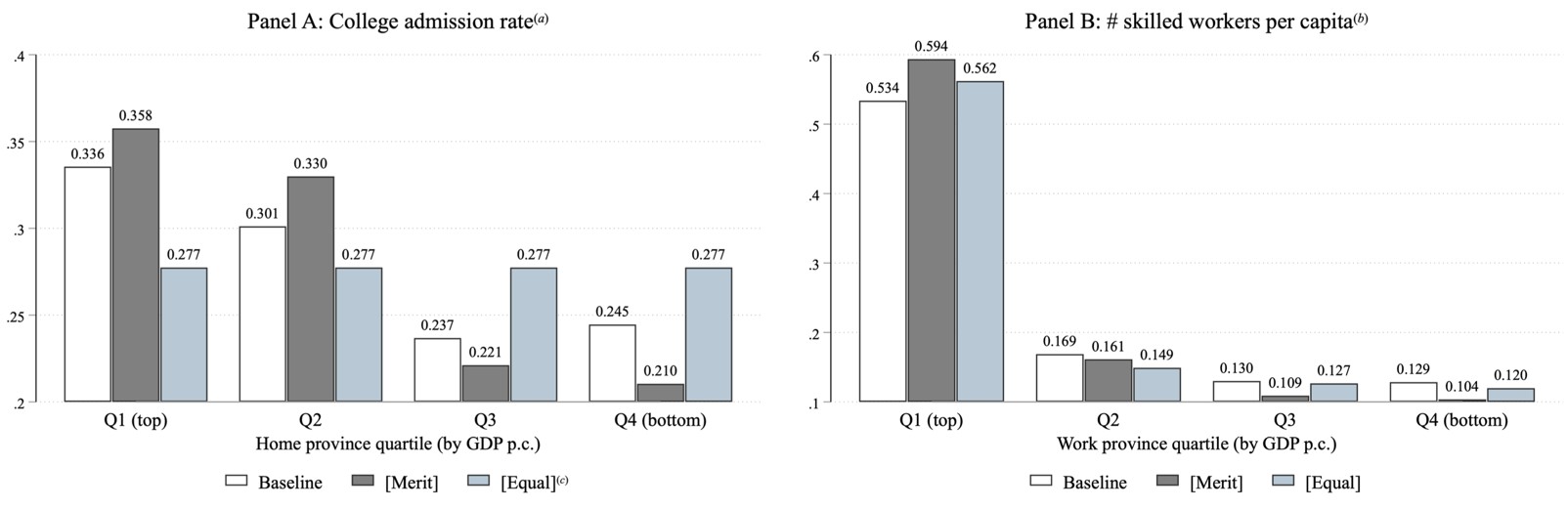
Notes: Panel A compares regional four-year college admission rates under the observed quota allocation, nationwide merit-based admission, and an allocation that equalizes admission rates across provinces. Panel B compares the corresponding supply of new college-educated workers, measured relative to local NCEE takers. Nationwide merit-based admission improves student-college matching but increases geographic inequality in both college access and the later location of graduates.
The second distributional margin: brain drain
The spatial consequences become even larger after graduation, as shown in Panel B of Figure 1. Removing provincial quotas allows more students from less developed regions to attend colleges in developed provinces. Because college location affects later work location, many remain there. In the merit-based counterfactual, the number of new college graduates working in the least developed provincial quartile, relative to local NCEE takers, falls by nearly 20%. A policy that improves aggregate student-college matching therefore also concentrates skilled labor more heavily in already developed regions.
A second counterfactual helps distinguish two policy margins. I consider a system that equalizes admission rates across provinces but does not prescribe specific origin-to-college flows (denoted as [Equal]). This arrangement produces slightly higher aggregate earnings than the observed quota system. The distinction is important. Regulating how many students from each province enter college is not the same as regulating where those students attend. The existing quota system does both because each seat links an origin province to a destination college. The second margin gives the system much of its ability to influence post-college migration.
What does the observed quota system appear to value?
If regional equality is measured only by college admission rates, the observed quota allocation lies inside the efficiency-equality frontier: among the alternatives considered, as in Panel A of Figure 2, some allocations deliver both higher aggregate earnings and more equal college access. The picture changes when equality is measured by the spatial supply of skilled labor in Panel B of Figure 2. Among the allocations examined, the observed quota system produces the smallest regional gap in new college-educated workers.
Figure 2: Efficiency-equality trade-offs under alternative college admission policies
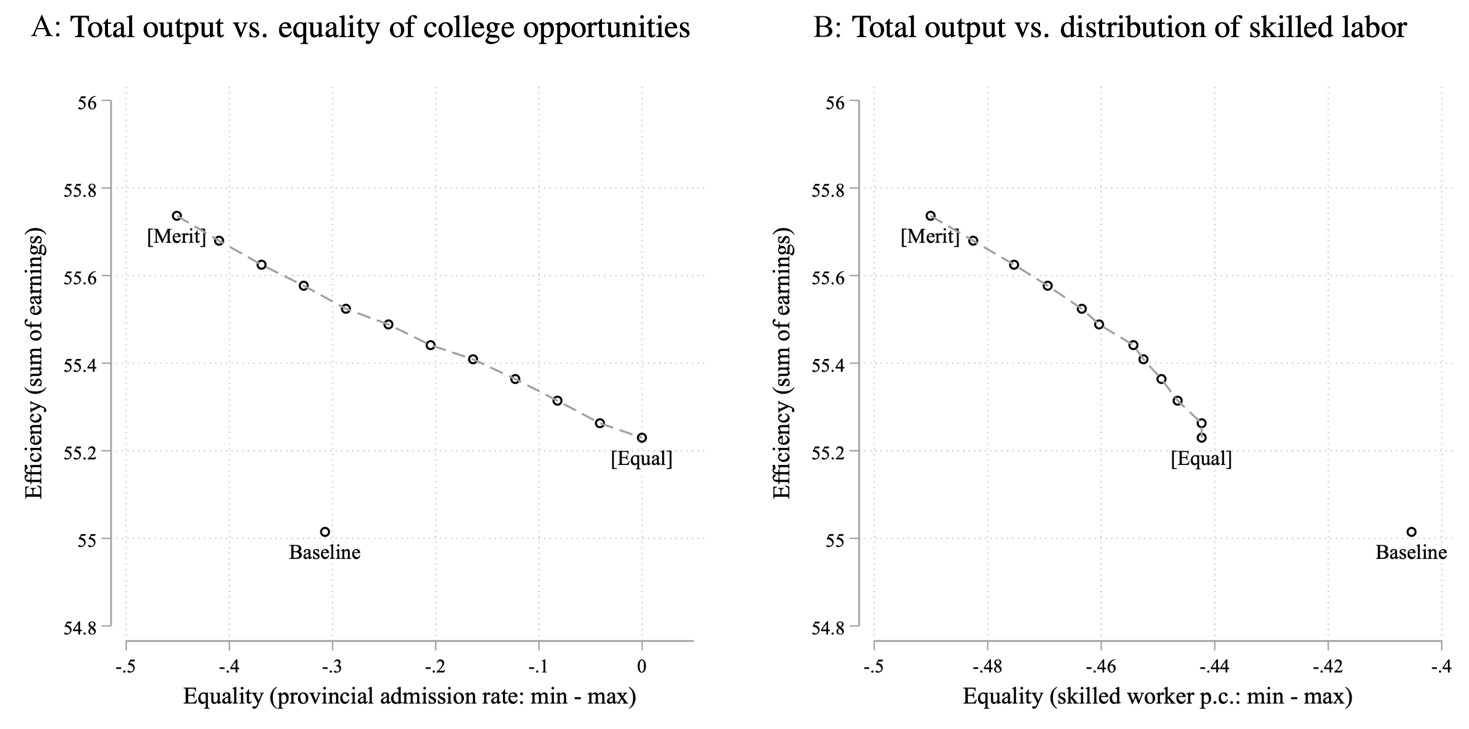
Notes: Panel A plots total initial earnings of new college graduates against equality in college admission rates across regions. Panel B plots the same efficiency measure against equality in the regional supply of college-educated workers. The observed quota allocation is difficult to rationalize if the policy objective is only equal college access, but is more consistent with a policy that also places weight on limiting regional disparities in skilled labor.
I use this frontier to ask what policy priorities would rationalize the observed allocation. When concern for unequal college access is modest, a one-percentage-point reduction in the regional skilled-labor gap must be valued at least 0.15% of aggregate output for the observed quota system to be preferred to the alternatives considered. This exercise does not establish that the quota system is optimal. The counterfactuals hold college locations and quality fixed, and the baseline model does not fully endogenize local wages and amenities as skilled workers relocate. Rather, the exercise clarifies what distinguishes the observed system: It gives up some efficiency not simply to equalize college access, but to limit the spatial concentration of skilled labor.
The broader lesson is that college admissions can function as place-based policy even when framed purely as education policy. More national competition can improve student-college matching while widening regional inequality in both access and skilled labor. Conversely, protecting lagging regions can retain human capital partly by constraining where students study and, indirectly, where they later work. College admission reform therefore involves more than deciding who should receive a scarce seat. When education and migration are spatially linked, it also helps determine the future geography of skilled labor.
Yu (Alan) Yang is at the Guanghua School of Management, Peking University.
References
Brotherhood, Luiz, Bernard Herskovic, and João Ramos. 2023. “Income-Based Affirmative Action in College Admissions.” Economic Journal 133 (653): 1810–45. https://doi.org/10.1093/ej/uead016.
Desmet, Klaus, Dávid Kristian Nagy, and E. Rossi-Hansberg. 2025. “Human Capital Accumulation Across Space.” National Bureau of Economic Research Working Paper No. 34310. https://www.nber.org/papers/w34310.
Dillon, Eleanor Wiske, and Jeffrey Andrew Smith. 2020. “The Consequences of Academic Match between Students and Colleges.” Journal of Human Resources 55 (3): 767–808. https://doi.org/10.3368/jhr.55.3.0818-9702R1.
Fu, Choo, Junjie Guo, Adam J. Smith, and Alan Sorensen. 2022. “Students’ Heterogeneous Preferences and the Uneven Spatial Distribution of Colleges.” Journal of Monetary Economics 129: 49–64. https://doi.org/10.1016/j.jmoneco.2022.03.001.
Groen, Jeffrey A. 2004. “The Effect of College Location on Migration of College-Educated Labor.” Journal of Econometrics 121 (1–2): 125–42. https://doi.org/10.1016/j.jeconom.2003.10.002.
Huang, Mian, Chunbing Xing, and Xiaoyong Cui. 2022. “Does College Location Affect the Location Choice of New College Graduates in China?” China & World Economy 30 (3): 135–60. https://doi.org/10.1111/cwe.12421.
Yang, Yu (Alan). 2026. “On the Spatial Allocation of College Seats: Human Capital Production and the Distribution of Skilled Labor.” Journal of International Economics 164: 104338. https://doi.org/10.1016/j.jinteco.2026.104338.

Latest
Most Popular
- VoxChina Covid-19 Forum (Second Edition): China’s Post-Lockdown Economic Recovery VoxChina, Apr 18, 2020
- China’s Great Housing Boom Kaiji Chen, Yi Wen, Oct 11, 2017
- China’s Joint Venture Policy and the International Transfer of Technology Kun Jiang, Wolfgang Keller, Larry D. Qiu, William Ridley, Feb 06, 2019
- Wealth Redistribution in the Chinese Stock Market: the Role of Bubbles and Crashes Li An, Jiangze Bian, Dong Lou, Donghui Shi, Jul 01, 2020
- The Dark Side of the Chinese Fiscal Stimulus: Evidence from Local Government Debt Yi Huang, Marco Pagano, Ugo Panizza, Jun 28, 2017
- Daily Price Limits and the Magnet Effect Ting Chen, Zhenyu Gao, Jibao He, Wenxi Jiang, Wei Xiong, Oct 25, 2017
- Evaluating Risk across Chinese Housing Markets Yongheng Deng, Joseph Gyourko, Jing Wu, Aug 02, 2017
- What Is Special about China’s Housing Boom? Edward L. Glaeser, Wei Huang, Yueran Ma, Andrei Shleifer, Jun 20, 2017
- Privatization and Productivity in China Yuyu Chen, Mitsuru Igami, Masayuki Sawada, Mo Xiao, Jan 31, 2018
- How did China Move Up the Global Value Chains? Hiau Looi Kee, Heiwai Tang, Aug 30, 2017