
A Bridge on Economic Issues between China and the World



 Facebook
 Twitter
 Instagram
 WeChat
 Email
The Impact of Patient Capital
Does the patience of venture capital come from its ultimate investors or from the fund managers who invest on their behalf? Combining a randomized survey experiment with Chinese venture capital (VC) managers and a 2014 reform that opened RMB-denominated VC funds to domestic insurers, we show that investor horizons pass through to fund strategies. After insurers entered, RMB funds held portfolio companies longer, backed younger startups, and saw more successful exits and patenting. This pass-through weakens when investors can sell their fund stakes in a liquid secondary market, a caution for current efforts to open private markets to retail investors.

Patient capital is widely recognized as a catalyst for breakthrough innovation (Ivashina and Lerner 2019). Private capital markets, particularly private equity, have long been regarded as a major source of patient capital. Private equity (PE), broadly defined, includes both buyout funds, which acquire mature companies, and venture capital (VC) funds, which finance young, high-risk startups whose technologies often take many years to commercialize. Patience matters most in VC, which is patient relative to public markets because investors commit capital for the full life of a fund, typically about ten years. Yet a fundamental question remains: In a market that is heavily intermediated, does patience come from the ultimate capital providers or from the intermediaries themselves? In the VC/PE context, intermediation frictions such as fixed-life fund structures, interim performance pressures, and exit timing can blunt the pass-through of preferences of limited partners (LPs), making investment horizons a choice of the general partner (GP) rather than simply a reflection of LP preferences (Gompers 1996; Barrot 2017).
This tension sits at the center of two global policy debates. In China, the push for patient capital is part of an effort to promote technological self-reliance in strategic sectors. Advanced sectors such as semiconductors, artificial intelligence, biotech, and clean energy demand long development cycles and substantial risk tolerance. Traditional short-horizon VC funds, operating under tight exit windows, are not well suited to these deep technologies. Policymakers have therefore moved to mobilize long-term institutional capital, such as insurance capital and public funds, to replace shorter-term investors such as wealthy individuals.
Conversely, in the United States, private markets face an intense push for democratization and retailization. Advocates argue that opening illiquid private assets to individual, nonaccredited investors allows households to access high-yield asset classes historically reserved for institutions or ultra-wealthy individuals. Critics counter that allowing short-term, liquidity-sensitive retail capital into private funds creates liquidity mismatches, heightens redemption risks, and shortens GP investment horizons.
In a recent study (Li et al. 2026), we examine the origins and impact of patient capital by studying China’s VC market, the second largest in the world. Unlike the US, which has a near-uniform fund duration of 10 years, fund duration varies substantially in China. We combine a randomized survey experiment with observational evidence surrounding a major regulatory reform in China. Our findings show that LP horizons directly affect VC fund strategies and portfolio outcomes, and that secondary-market liquidity for LP stakes weakens this relationship.
Do fund managers respond to the patience of their investors?
To isolate whether GPs strategically adapt to LP horizons while holding all else constant, we surveyed experienced VC fund managers in China. We presented them with randomized hypothetical LP compositions and asked them to formulate corresponding fund strategies. We also directly asked about their beliefs regarding LPs’ horizons.
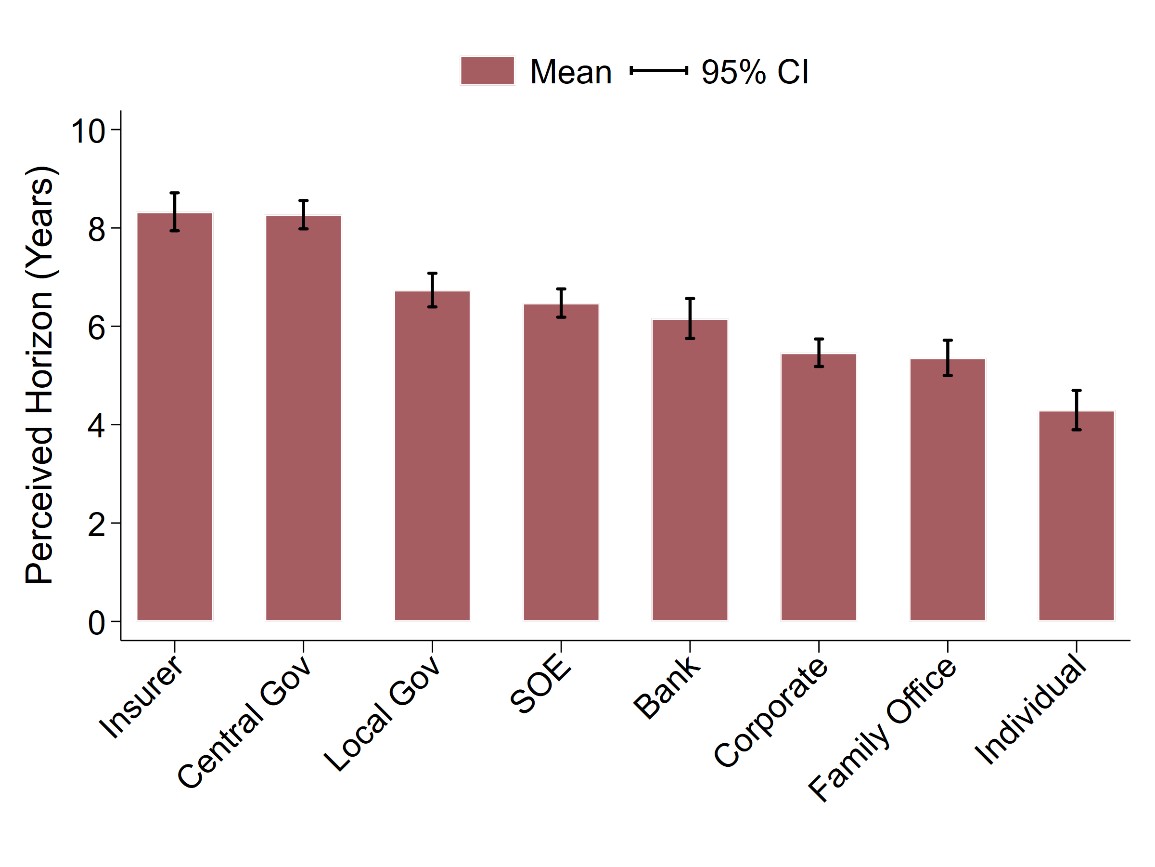
Fund managers revealed distinct beliefs regarding LP horizons, ranking insurance companies as the most patient investors and individual investors as the least patient. Central and local governments, along with corporations, fell in between (see Figure 1). Using actual data on LPs’ secondary sales of fund stakes, we find a similar ranking: Insurers are the least likely to exit funds early through secondary sales, while individuals are the most likely, with governments and corporations in between. This suggests that GPs’ beliefs are largely accurate.
Figure 1. Perceived limited partner (LP) horizon by LP type (from the randomized survey experiment in Li et al., 2026)
When evaluating randomized LP mixes, fund managers shift strategies with investor composition. As the investor base becomes more patient, fund managers extend the target life of their funds. A larger share of insurance capital leads managers to lengthen both the overall fund life and the expected holding period for portfolio companies. Fund managers cite investment horizons, risk tolerance, and return expectations as the primary drivers of these adjustments, while governance demands and fundraising pressures are considered less important.
A 2014 reform created a real-world test
To test whether the above behaviors translate into actual investment decisions and startup performance, we evaluate a quasi-natural experiment in China. In 2014, the China Insurance Regulatory Commission allowed domestic insurance companies to invest directly in VC funds for the first time. This deregulation applied only to RMB-denominated funds, while USD-denominated funds were unaffected. Both types of funds are managed by Chinese GP firms and invest in Chinese startups, except that RMB funds are raised domestically while USD funds are raised overseas. Given that domestic LPs were dominated by short-term investors such as individuals and corporations before 2014, the reform represented a large shock to investor patience for RMB funds (see panel (a) of Figure 2). We leverage this to implement a difference-in-differences design, comparing RMB and USD funds managed by the same GP. This within-GP comparison holds fixed GP characteristics such as skill, style, access, and networks. The two types of funds did draw on different investors before the reform. Because of capital controls, RMB funds could be raised only from domestic investors, while USD funds were raised from foreign institutions such as endowments, foundations, pension funds, and foreign insurers. Our design compares changes over time rather than levels, so these fixed differences do not drive our results: Before 2014, the outcomes of RMB and USD funds trended in parallel (Figure 2), and our results hold when we control for differences in financial conditions across the two investor markets, such as stock returns, interest rates, and initial public offering (IPO) activity.
Figure 2. Event study plots from Li et al. (2026)
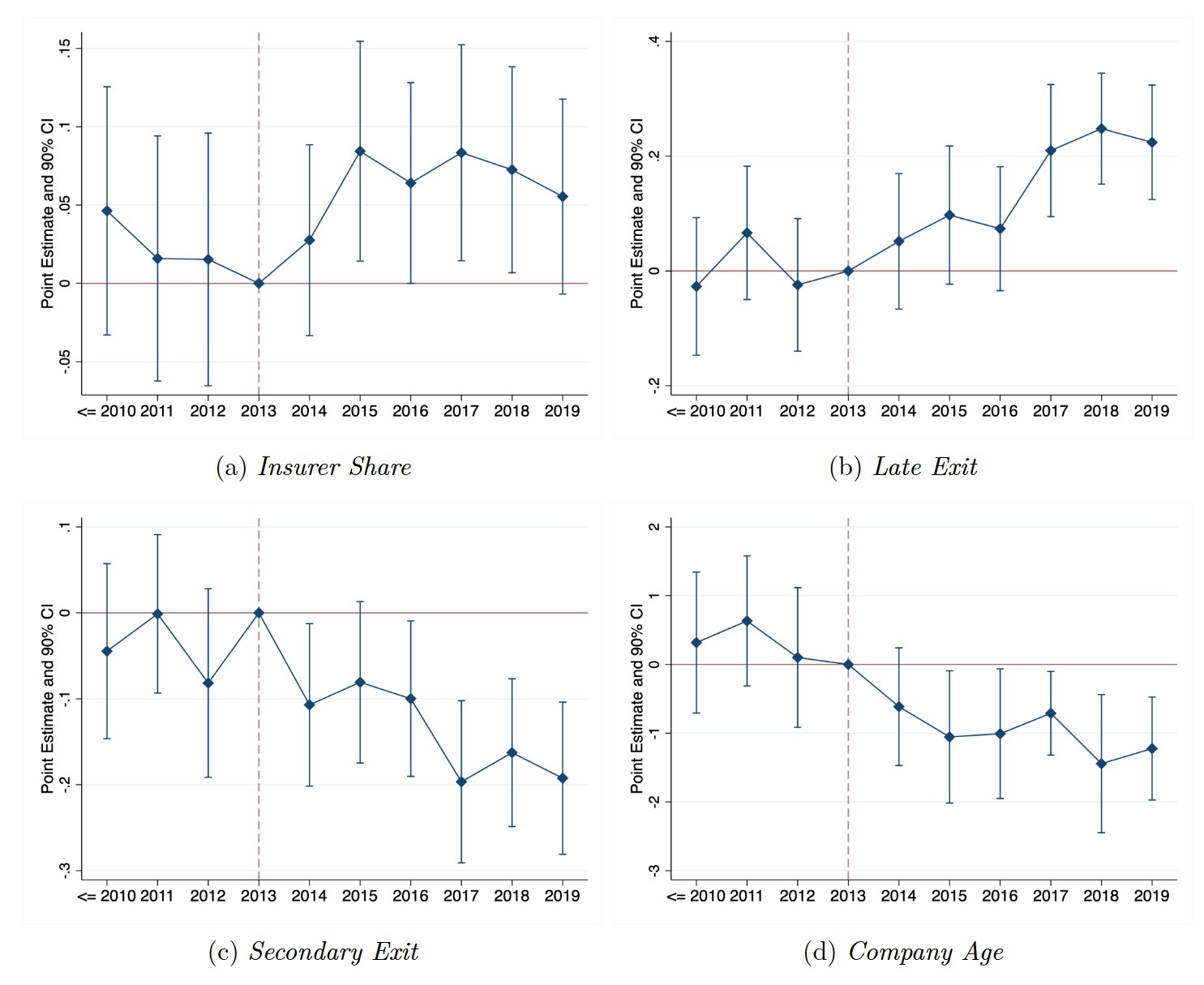
Analyzing Chinese VC funds launched between 2005 and 2019 reveals three key stages of patience pass-through. After the reform, RMB funds became substantially more likely to secure an insurance LP than USD funds managed by the same GPs. The entry of insurer LPs primarily displaced individual investors, who have the shortest investment horizons. As a result, the overall investor base became more patient.
Moreover, RMB funds adjusted their investment strategies toward longer horizons and earlier-stage deals. Funds significantly extended the holding periods of their portfolio companies (panel (b) of Figure 2), while secondary exits of these companies dropped sharply (panel (c) in Figure 2). At the same time, funds shifted their investments toward younger, earlier-stage companies, backing startups at a much earlier stage in their life cycle (panel (d) of Figure 2).
This tilt toward younger, riskier companies did not compromise fund performance. Startups backed by RMB funds post-reform experienced an increase in the likelihood of a successful exit through an IPO or acquisition, and were more likely to become top patent producers following investment.
Secondary market liquidity determines how much patience passes through
When secondary markets are illiquid, LPs are locked into the fund, compelling GPs to align the timing of the fund’s cash flows with LPs’ horizons. In contrast, a deep and liquid secondary market gives LPs an outside option to achieve their desired horizon, decoupling LP preferences from the GP’s fund strategy. Consistent with this, we find that the effects of insurer entry on fund strategies and startup performance are significantly muted in periods of high secondary-market liquidity.
What does this mean for policy?
Our findings offer two policy insights. First, the “color of money” matters. Policies aimed at supporting innovation often focus on the total amount of capital available. Our results suggest that the horizon of the ultimate capital provider can be just as important. Long-gestation technologies require money that can wait. Second, the current push to broaden retail access to private markets may erode patience in capital, especially if retail access is structured in ways that allow strong impatience pass-through.
References
Barrot, Jean-Noël. 2017. “Investor Horizon and the Life Cycle of Innovative Firms: Evidence from Venture Capital.” Management Science 63 (9): 3021–43. https://doi.org/10.1287/mnsc.2016.2482.
Gompers, Paul A. 1996. “Grandstanding in the Venture Capital Industry.” Journal of Financial Economics 42 (1): 133–56. https://doi.org/10.1016/0304-405X(96)00874-4.
Ivashina, Victoria, and Josh Lerner. 2019. Patient Capital: The Challenges and Promises of Long-Term Investing. Princeton University Press.
Li, Yingxiang, Tong Liu, and Ting Xu. 2026. “The Impact of Patient Capital.” National Bureau of Economic Research Working Paper No. 35711. https://doi.org/10.3386/w35711.

Latest
Most Popular
- VoxChina Covid-19 Forum (Second Edition): China’s Post-Lockdown Economic Recovery VoxChina, Apr 18, 2020
- China’s Great Housing Boom Kaiji Chen, Yi Wen, Oct 11, 2017
- China’s Joint Venture Policy and the International Transfer of Technology Kun Jiang, Wolfgang Keller, Larry D. Qiu, William Ridley, Feb 06, 2019
- Wealth Redistribution in the Chinese Stock Market: the Role of Bubbles and Crashes Li An, Jiangze Bian, Dong Lou, Donghui Shi, Jul 01, 2020
- The Dark Side of the Chinese Fiscal Stimulus: Evidence from Local Government Debt Yi Huang, Marco Pagano, Ugo Panizza, Jun 28, 2017
- Daily Price Limits and the Magnet Effect Ting Chen, Zhenyu Gao, Jibao He, Wenxi Jiang, Wei Xiong, Oct 25, 2017
- Evaluating Risk across Chinese Housing Markets Yongheng Deng, Joseph Gyourko, Jing Wu, Aug 02, 2017
- What Is Special about China’s Housing Boom? Edward L. Glaeser, Wei Huang, Yueran Ma, Andrei Shleifer, Jun 20, 2017
- Privatization and Productivity in China Yuyu Chen, Mitsuru Igami, Masayuki Sawada, Mo Xiao, Jan 31, 2018
- How did China Move Up the Global Value Chains? Hiau Looi Kee, Heiwai Tang, Aug 30, 2017