
A Bridge on Economic Issues between China and the World



 Facebook
  Twitter
  Instagram
 WeChat
  Email
Email From Units to Regions: How the Level of Carbon Dioxide Regulation Reshapes Efficiency in China’s Power Sector
China’s coal-fired power system combines binding generation targets with carbon dioxide (CO2) caps set at different administrative levels. Using generator-level data from the China Southern Power Grid Corporation and a structural model that captures differences in returns to scale and unobserved productivity, we show that moving coordination from plants to provinces or the regional grid can lower both coal costs and CO2 emissions without reducing aggregate generation. Relative to plant-level allocation, province-level coordination cuts coal costs by 8.29% and emissions by 4.65%, while region-level coordination delivers reductions of 11.50% and 5.11%, respectively. A separate counterfactual shows that information granularity also matters: under province-level coordination, relying on plant-level average productivity rather than generator-level productivity raises coal costs by 0.34% and emissions by 0.70%. Accounting for productivity differences among generators within the same plant therefore creates additional scope to direct output toward the most efficient units. The gains come mainly from shifting generation toward larger, more efficient units and are strengthened by generator-level productivity information; our analysis also cautions that unit-specific caps can distort dispatch when they conflict with binding output targets.

Policy innovation often boils down to a fundamental question: At what level should regulation be implemented? In China’s coal-fired power sector, carbon dioxide (CO₂) constraints and generation targets can be coordinated at the plant, province, or regional grid level. This choice is critical because production efficiency varies widely—not just across provinces and plants, but even across individual generator units within the same plant.
The same question arises outside China: In the United States and Europe, electricity is dispatched through regional or cross-border systems while environmental and reliability rules may be set at federal, national, state, or plant levels. Research on market restructuring and emissions trading shows that the organization and geographic scope of these rules can affect operating efficiency and compliance costs (Ellerman and Buchner 2007, Fabrizio et al. 2007, Borenstein and Bushnell 2015).
In a new study (Chen et al. 2026), we develop a generator-level structural model and run counterfactual simulations to explore how different levels of coordination affect performance. One central finding emerges clearly: Raising the level of coordination for electricity generation allocation—effectively aligning it with higher-level emissions regulation—can simultaneously reduce both coal costs and CO₂ emissions. These gains come primarily from shifting output toward larger, more efficient generating units. The benefits are even greater when regulators can observe generator-level productivity rather than relying on plant-wide averages.
Why the level of regulation matters
China’s electricity dispatch has long blended market mechanisms with administrative planning. Provincial authorities set annual generation targets for power plants to meet local demand. At the same time, CO₂ regulation in the power sector has evolved significantly. Prior to 2021, regulation was largely regional or provincial, with varying standards. In 2021, a nationwide generator-level framework was introduced, tying emission caps to unit-specific benchmarks.
A key practical challenge is that generation targets are binding output requirements, while emission caps are upper limits. When these conflict, they can create inefficient allocation of power generation. It is therefore crucial to understand what could be achieved under a more coherent regulatory approach.
A new generator-level model: Capturing “double heterogeneity”
Most existing research uses plant-level data. We instead model production at the generator unit level —where dispatch decisions and real efficiency differences reside. Our structural model incorporates:
• A generator-level Leontief production function, reflecting limited substitutability between capital capacity and heat input.
• Two dimensions of heterogeneity (“double heterogeneity”):
o Different returns to scale by generator size (large/medium/small).
o Unobserved productivity differences even among units of the same size.
• A new control-function estimation approach that uses auxiliary electricity consumption —the power a generator uses to run its own equipment—as a proxy for unobserved productivity.
Key findings: Large units are more efficient, but dispersion is high
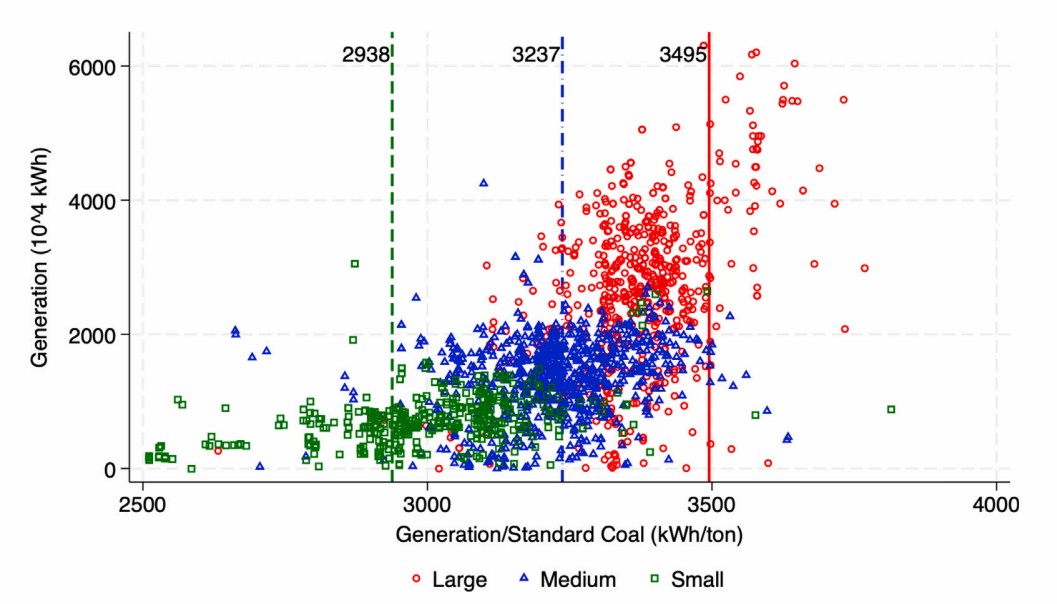
Our data reveal a clear efficiency hierarchy, measured in kilowatt-hours generated per ton of standard coal equivalent (SCE):
• Large units: 3,495 kWh/ton SCE
• Medium units: 3,237 kWh/ton SCE
• Small units: 2,938 kWh/ton SCE
However, efficiency varies widely even within each category, as shown in Figure 1. Some large units perform worse than the average medium or small unit. This dispersion highlights significant potential for reallocation gains.
Figure 1
Counterfactual: What if we coordinated at higher levels?
Holding total generation fixed, we simulate reallocation of output across generators under three coordination levels:
• Plant-level: Reallocation only within the same plant
• Province-level: Reallocation across all plants within a province
• Region-level: Reallocation across provinces within a regional grid
Such reallocation is feasible to the extent that transmission capacity, reliability requirements, ramping needs, fuel contracts, and interprovincial trading rules permit. Our simulations should be interpreted as an efficiency benchmark; realizing the gains would require stronger regional dispatch, transmission, settlement, and compensation arrangements (Borenstein and Bushnell 2015; Wei et al. 2018). We then compute the resulting CO₂ emissions, treating them as implied emission caps consistent with meeting generation targets, as shown in Table 1.
Table 1. Results for the Central Southern Power Grid (CSPGC)
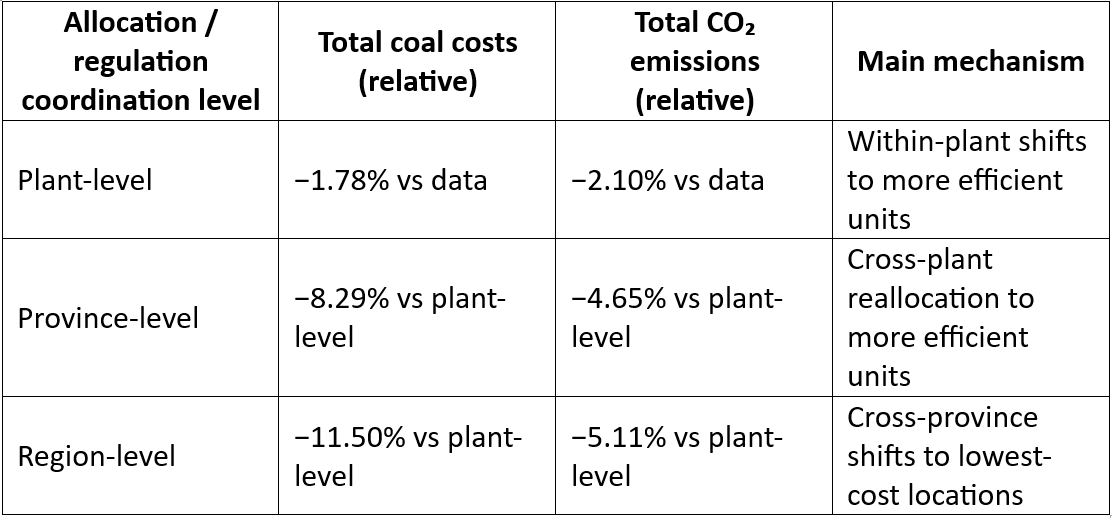
Higher-level coordination allows generation to move to units with lower marginal coal costs and lower emissions per kWh. In some cases, entire plants or units become inactive as output concentrates in the most efficient generators.
The value of granular data
What if regulators have only plant-level averages, not generator-specific data? We find that using plant-average productivity instead of generator-level data increases coal costs by 0.34% and emissions by 0.70% under province-level coordination.
While these percentages seem modest, the absolute impacts are large at the scale of China’s power system—highlighting that better monitoring infrastructure can pay for itself through improved dispatch efficiency.
A caution on generator-level caps: Avoid unintended distortions
When we simulate the 2021 generator-level emission caps within our framework, we find they can sometimes conflict with binding generation targets. This can slightly reduce total generation (by ~0.47% in our simulation) and, in some cases, shift generation away from large efficient units toward smaller ones, raising both costs and emissions compared to a nondistorting benchmark. This doesn’t argue against national standards, but rather underscores that emission caps must be designed in harmony with dispatch constraints to avoid new inefficiencies.
Policy implications
Our results point toward a policy package centered on coordination and information:
• Coordinating at higher administrative levels where feasible. Province- or region-level reallocation can achieve significant cost and emission savings—even with today’s technology.
• Investing in generator-level monitoring and data systems to capture within-plant heterogeneity and support better dispatch decisions.
• Designing emissions caps to be compatible with binding generation constraints to avoid conflicts that undermine efficiency.
• Linking “energy structure upgrading” to smarter reallocation. When retiring coal capacity, coordinated reallocation can amplify emission reductions. For example, a 13.46% reduction in coal capacity could yield CO₂ cuts of 14.4% under plant-level coordination, or up to 16.6% under province-level coordination.
Conclusion
The effectiveness of CO₂ regulation in China’s power sector depends not only on how strict the caps are, but also on where coordination happens and how much operational detail policymakers can see. A generator-level perspective reveals substantial efficiency gaps and shows that higher-level coordination can reduce both coal costs and emissions by shifting generation to the most efficient units. In a system balancing decarbonization with reliability, these low-hanging efficiency gains can ease the energy transition—through fewer distortions, better data, and smarter allocation rules.
Zhiyuan Chen, Rong Luo, and Li Su (Renmin University of China)
References
Borenstein, Severin, and James Bushnell. 2015. “The U.S. Electricity Industry After 20 Years of Restructuring.” Annual Review of Economics 7: 437–63. https://doi.org/10.1146/annurev-economics-080614-115630.
Cao, Jing, Mun S. Ho, Rong Ma, and Fei Teng. 2021. “When Carbon Emission Trading Meets a Regulated Industry: Evidence from the Electricity Sector of China.” Journal of Public Economics 200, 104470. https://doi.org/10.1016/j.jpubeco.2021.104470.
Chen, Zhiyuan, Rong Luo, and Li Su. 2026. “CO₂ Emission Regulation and Generation Allocation with Heterogeneous Coal-Fired Generators.” Journal of Development Economics 180, 103711. https://doi.org/10.1016/j.jdeveco.2025.103711.
Ellerman, A. Denny, and Barbara K. Buchner. 2007. “The European Union Emissions Trading Scheme: Origins, Allocation, and Early Results.” Review of Environmental Economics and Policy 1 (1): 66–87. https://doi.org/10.1093/reep/rem003.
Fabrizio, Kira R., Nancy L. Rose, and Catherine D. Wolfram. 2007. “Do Markets Reduce Costs? Assessing the Impact of Regulatory Restructuring on US Electric Generation Efficiency.” American Economic Review 97 (4): 1250–77. https://doi.org/10.1257/aer.97.4.1250.
Fowlie, Meredith, Mar Reguant, and Stephen P. Ryan. 2016. “Market-Based Emissions Regulation and Industry Dynamics.” Journal of Political Economy 124 (1): 249–302. https://doi.org/10.1086/684484.
Gao, Hang, and Johannes Van Biesebroeck. 2014. “Effects of Deregulation and Vertical Unbundling on the Performance of China’s Electricity Generation Sector.” Journal of Industrial Economics 62 (1): 41–76. https://doi.org/10.1111/joie.12034.
Ma, Chunbo, and Xiaoli Zhao. 2015. “China’s Electricity Market Restructuring and Technology Mandates: Plant-Level Evidence for Changing Operational Efficiency.” Energy Economics 47: 227–237. https://doi.org/10.1016/j.eneco.2014.11.012.
Wei, Yi-Ming, Hao Chen, Chi Kong Chyong, Jia-Ning Kang, Hua Liao, and Bao-Jun Tang. 2018. “Economic Dispatch Savings in the Coal-Fired Power Sector: An Empirical Study of China.” Energy Economics 74, 330–42. https://doi.org/10.1016/j.eneco.2018.06.017.

Latest
Most Popular
- VoxChina Covid-19 Forum (Second Edition): China’s Post-Lockdown Economic Recovery VoxChina, Apr 18, 2020
- China’s Great Housing Boom Kaiji Chen, Yi Wen, Oct 11, 2017
- China’s Joint Venture Policy and the International Transfer of Technology Kun Jiang, Wolfgang Keller, Larry D. Qiu, William Ridley, Feb 06, 2019
- The Dark Side of the Chinese Fiscal Stimulus: Evidence from Local Government Debt Yi Huang, Marco Pagano, Ugo Panizza, Jun 28, 2017
- Wealth Redistribution in the Chinese Stock Market: the Role of Bubbles and Crashes Li An, Jiangze Bian, Dong Lou, Donghui Shi, Jul 01, 2020
- Evaluating Risk across Chinese Housing Markets Yongheng Deng, Joseph Gyourko, Jing Wu, Aug 02, 2017
- Daily Price Limits and the Magnet Effect Ting Chen, Zhenyu Gao, Jibao He, Wenxi Jiang, Wei Xiong, Oct 25, 2017
- What Is Special about China’s Housing Boom? Edward L. Glaeser, Wei Huang, Yueran Ma, Andrei Shleifer, Jun 20, 2017
- Privatization and Productivity in China Yuyu Chen, Mitsuru Igami, Masayuki Sawada, Mo Xiao, Jan 31, 2018
- How did China Move Up the Global Value Chains? Hiau Looi Kee, Heiwai Tang, Aug 30, 2017