
A Bridge on Economic Issues between China and the World



 Facebook
  Twitter
  Instagram
 WeChat
  Email
Email From Heat to High-Tech: How Innovation Responds to Climate Change
Climate change is driving firms to innovate—not just where heat strikes, but through shifting demand across the economy. Evidence from China shows that rising temperatures stimulate both adaptation and mitigation technologies. As households, firms, and governments respond to climate risks, new market signals travel through product markets and supply chains, encouraging higher-quality climate-related innovation across sectors.
Heatwaves are becoming more frequent and severe, and their economic consequences are attracting growing attention in both research and policy discussions. A large body of literature shows that rising temperatures affect labor productivity, health outcomes, and agricultural production. More recently, economists have begun to examine how societies adapt to these changes. Much of this work focuses on households or agriculture, where adaptation may take the form of behavioral adjustments, migration, or changes in production practices.
The role of firms, however, remains less well understood. Firms are central to adaptation because they develop and supply the technologies that allow economies to respond to climate risks. Innovation may therefore be an important channel through which societies adjust to climate change. Evidence from the United States suggests that climate shocks can influence technological development in agriculture (Moscona and Sastry 2023). Yet little is known about how climate change affects innovation across the broader industrial sector, particularly in developing economies.
In Long and Wang (2025), we study how firms in China respond to rising temperatures through technological innovation. Our findings show that climate change significantly increases innovation in both adaptation technologies, which help societies cope with climate impacts, and mitigation technologies, which reduce greenhouse gas emissions. Importantly, the firms that innovate are not necessarily those directly exposed to extreme heat. Instead, innovation responds to changes in market demand across the economy.
Measuring patent-specific climate change exposure
Most existing studies measure climate exposure based on the location of firms. This approach implicitly assumes that firms innovate primarily in response to their own local climate risks. Yet firms often develop technologies for customers located elsewhere. A company based in a relatively temperate region may design cooling systems, construction materials, or agricultural technologies that are used in much hotter places.
This observation suggests that innovation incentives depend not only on where firms operate but also on where their products are used. To capture this, we measure patent-level climate exposure, linking patents to the products they cover and the geographic demand for those products. Using natural language processing, we match patent descriptions to products, then calculate heat exposure based on where demand for these products is concentrated. This method reveals that innovation incentives depend on who needs the technology, rather than who is exposed to heat directly.
Figure 1. Local heat exposure and climate-related patents
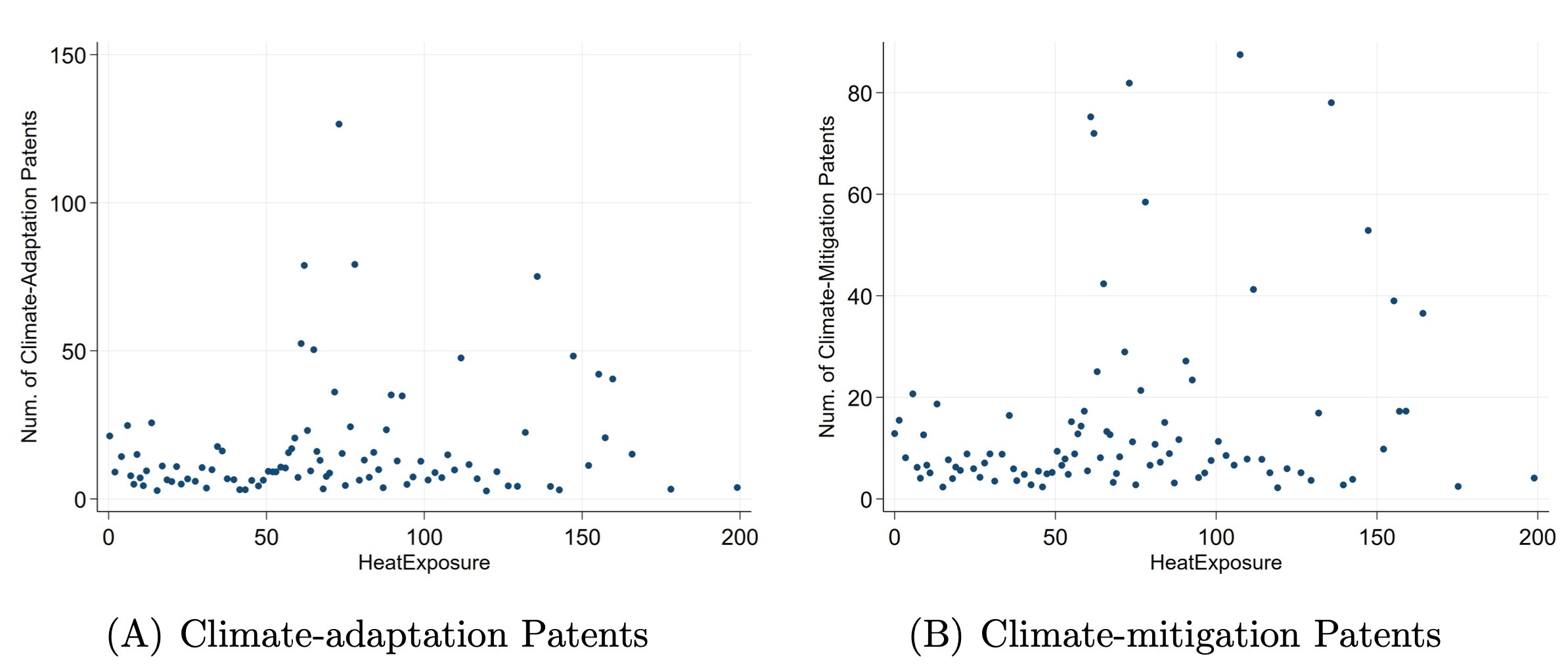
Notes: We show that local heat exposure has little correlation with climate-related patenting. This validates our approach of moving beyond geography to capture more nuanced exposure pathways.
Climate change leads to more and better climate-related innovation
Using this patent-level climate exposure, we find that heat exposure since 2003 leads to:
• An 8.62% increase in climate-adaptation patents (e.g., cooling technologies)
• A 10.68% increase in climate-mitigation patents (e.g., carbon reduction technologies)
• No significant change in non-climate-related patents (which serves as a placebo, suggesting no crowding-out effect).
Moreover, we find that climate-induced patents tend to be of higher quality, as measured by citations, which indicates meaningful technological advancement rather than strategic or defensive filing.
Spillovers along the supply chain
One important finding is that climate-related innovation does not stop at the directly affected product. Using input-output tables, we trace the relationships between upstream and downstream sectors. For example, rising demand for air conditioners leads to innovation not only in cooling systems but also in upstream cooling chemicals and downstream smart grids.
When we include both direct and supply chain–linked product exposure, the estimated impact of climate change on innovation rises substantially. Our findings suggest that supply chain spillovers increase the innovation response by four- to five fold compared to direct effects alone, which aligns with evidence from recent studies on technological spillovers (Pankratz and Schiller 2024).
Why do firms innovate and who innovates?
We identify two driving forces explaining why firms innovate:
• Citizen awareness and demand shift: Extreme heat affects both supply and demand. We use Baidu Index search data to track public attention to climate change. Cities experiencing more heat see more searches for terms like climate change and global warming. We also observe higher household demand for air conditioners—a clear example of adaptive behavior. This demand shift feeds back into the innovation process. Firms in cities with high citizen climate awareness file significantly more adaptation and mitigation patents.
• Government awareness and policy response: China’s local governments have responded to climate stress by tightening regulations. We construct an index of government climate regulations based on keywords in official policy documents and firms’ CO₂ shadow prices. Cities with greater heat exposure tend to have higher awareness and enforce stricter climate policies. Firms operating under tighter regulations are more likely to invest in mitigation technologies. This is consistent with the role of top-down incentives in guiding low-carbon innovation, especially in contexts like China where governments actively shape industrial priorities.
We find substantial heterogeneity across:
• Technologies: The strongest effects are in technologies classified under “human necessities,” especially agriculture and health.
• Regions: Innovation is higher in areas with greater citizen and government awareness of climate change.
• Inventors: Private firms show stronger responses than public entities, which likely reflects greater profit sensitivity. However, we also find that public-private partnerships play a larger role in mitigation than adaptation, reflecting the regulatory context.
Implications for climate change and innovation
Climate change is undeniably a severe challenge, but it also acts as a powerful market signal that reshapes the innovation landscape. Our findings highlight how rising temperatures reshape innovation landscapes through both direct and indirect channels. More broadly, the results highlight the role of market signals and policy incentives in shaping the direction of technological progress. Climate change is not only an environmental challenge but also a force that redirects innovation toward technologies that help societies adapt and transition to a lower-carbon economy.
Xianling Long, assistant professor, China Center for Economic Research and National School of Development, Peking University; Zhiqiang Wang, PhD candidate, School of Economics, Peking University
References
Long, Xianling, and Zhiqiang Wang. 2025. “From Heat to High-Tech: How Innovation Responds to Climate Change.” Journal of Development Economics 176: 103525. https://doi.org/10.1016/j.jdeveco.2025.103525.
Moscona, Jacob, and Karthik A. Sastry. 2023. “Does Directed Innovation Mitigate Climate Damage? Evidence from US Agriculture.” Quarterly Journal of Economics 138 (2): 637–701. https://doi.org/10.1093/qje/qjac039.
Pankratz, Nora M. C., and Christoph M. Schiller. 2024. “Climate Change and Adaptation in Global Supply-Chain Networks.” Review of Financial Studies 37 (6): 1729–77. https://doi.org/10.1093/rfs/hhad093.

Latest
Most Popular
- VoxChina Covid-19 Forum (Second Edition): China’s Post-Lockdown Economic Recovery VoxChina, Apr 18, 2020
- China’s Great Housing Boom Kaiji Chen, Yi Wen, Oct 11, 2017
- China’s Joint Venture Policy and the International Transfer of Technology Kun Jiang, Wolfgang Keller, Larry D. Qiu, William Ridley, Feb 06, 2019
- The Dark Side of the Chinese Fiscal Stimulus: Evidence from Local Government Debt Yi Huang, Marco Pagano, Ugo Panizza, Jun 28, 2017
- Wealth Redistribution in the Chinese Stock Market: the Role of Bubbles and Crashes Li An, Jiangze Bian, Dong Lou, Donghui Shi, Jul 01, 2020
- Evaluating Risk across Chinese Housing Markets Yongheng Deng, Joseph Gyourko, Jing Wu, Aug 02, 2017
- Daily Price Limits and the Magnet Effect Ting Chen, Zhenyu Gao, Jibao He, Wenxi Jiang, Wei Xiong, Oct 25, 2017
- What Is Special about China’s Housing Boom? Edward L. Glaeser, Wei Huang, Yueran Ma, Andrei Shleifer, Jun 20, 2017
- Privatization and Productivity in China Yuyu Chen, Mitsuru Igami, Masayuki Sawada, Mo Xiao, Jan 31, 2018
- How did China Move Up the Global Value Chains? Hiau Looi Kee, Heiwai Tang, Aug 30, 2017