
A Bridge on Economic Issues between China and the World



 Facebook
  Twitter
  Instagram
 WeChat
  Email
Email How Rural Pensions Boosted China's Economy
China’s New Rural Pension Scheme unexpectedly lowered the high cost of migration by freeing younger workers from household duties – boosting migration, wages, household welfare, and even national GDP.

A major puzzle in developing economies is why so many people remain in low-paying agricultural jobs when migrants in the city earn much higher wages than stayers in the rural areas (Lagakos et al. 2023, Gollin et al. 2021). There are two popular explanations in the literature. The first attributes these gaps to differences in unobserved worker characteristics and sorting (see Herrendorf and Schoellman 2018; Alvarez 2020; Hamory et al. 2021). The second emphasizes barriers to worker mobility between sectors preventing people from moving (see Tombe and Zhu 2019; Lagakos et al. 2020; Lagakos et al. 2023).
We explore this question in the context of China (Gai, Guo, Li, Shi, and Zhu 2025). Using a large dataset covering approximately 80,000 workers from 2003 to 2013, we find that the main barrier to urban migration is the high cost of relocation, rather than a lack of skill among rural workers. Unexpectedly, we also find that a pension programme for the elderly provided a powerful solution to this problem, boosting not just migration but also household welfare and GDP.
An invisible wall around the city
Our research demonstrates that a significant productivity gap exists. After accounting for worker characteristics, jobs in the non-agricultural sector pay approximately 33% more than those in agriculture. There are two potential explanations for this disparity:
1. Sorting, where skilled workers are more likely to be employed in urban areas.
2. Migration barriers, which prevent rural workers from relocating to cities despite the substantial potential earnings gains.
An unexpected solution: The New Rural Pension Scheme
Between 2009 and 2012, China implemented the New Rural Pension Scheme (NRPS). The policy provided a basic income transfer to rural residents aged 60 and over, constituting approximately 68% of their annual income. While the primary goal was to support the elderly, the policy also generated significant spillover effects on younger generations.
The mechanism works as follows:
1. Pension for the elderly: Older family members receive a steady income from the government.
2. Less farm work, more home help: With this financial security, we find that, the elderly reduce their own labour on the farm. They can then spend more time on ‘home production’ – caring for grandchildren and attending to their own needs.
3. Young workers are freed up: This frees younger family members from domestic duties, making it easier for them to leave the village and work in higher-paying jobs in the city.
In doing so, the pension programme effectively lowered the migration cost for young workers – providing increased support for childcare and eldercare from their elderly parents.
More migration, higher remuneration
Leveraging the staggered, county-by-county rollout of the NRPS, we estimate the impact of the pension program on migration and labour supply among both the elderly and young adults. To identify the causal effect of migration on labour earnings, we further employ an instrumental variable approach, interacting the timing of the NRPS rollout with the presence of pension-eligible elderly household members. Our analysis yields the following findings regarding the effects of the pension program:
• Increased migration: Young workers in households with pension-eligible elders were 4.2 percentage points more likely to be employed in the urban non-agricultural sector than their peers in households without elderly members.
• Higher wages: For the specific group of workers who moved because of the pension programme, daily earnings increased by a massive 86% – suggesting that they were previously held back by very high migration costs.
• Labour reallocation at home: The policy created a labour shift within the family. As predicted, the elderly significantly decreased their workdays, while young members freed up from domestic responsibilities increased their labour supply.
A boost for the whole economy
Beyond the effects on individual families, we developed a comprehensive model incorporating joint household production in agriculture, shared home production, labour supply, and labour sorting across sectors. This model is then estimated and employed to simulate the broader impacts of the policy. The results are substantial:
• The NRPS is estimated to have increased China's total GDP and welfare by 2.4% and 15%, respectively.
• A counterfactual experiment shows that scaling up the pension payments fivefold could boost GDP by an additional 4.2%.
• The pension's positive impact on GDP is comparable to what could be achieved by a major reform of the hukou (household registration) system, which is a well-known direct barrier to migration. Interestingly, the two policies work differently. While hukou reform boosts GDP by reallocating labour between sectors, the pension policy works primarily by reducing labour misallocation within the household and increasing the overall labour supply of young, productive workers.
Figure 1. Hukou and NRPS
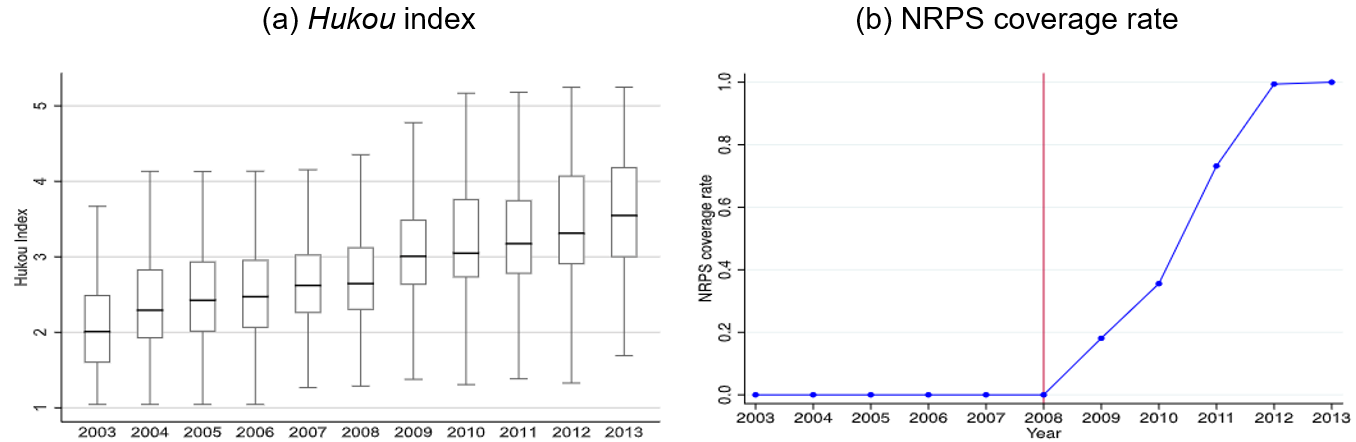
Notes: In Panel (a), the middle lines show the mean; the boxes represent the 25th and 75th percentiles; and the vertical lines indicate the range.
Reducing rural-urban inequality and improving overall welfare
• Our counterfactual analysis shows that scaling up the pension payment fivefold, financed with a labour income tax of young rural workers, could improve the welfare of old rural workers, young rural workers, and urban workers by 34%, 8% and 4%, respectively. Therefore, the policy could result in a large reduction in rural-urban inequality.
• Overall, the policy could increase national welfare by 28.5%.
Policy implications: Social protection for economic growth
We conclude that social safety nets, such as pensions, can have powerful and unexpected positive effects on economic growth. By providing old-age security, governments can indirectly break down barriers to migration, improve family labour allocation, and ultimately boost national income and welfare.
In recent years, many Chinese economists have argued that China should increase pension payments for rural residents to reduce rural-urban inequality. Our analysis shows that such a policy is pareto improving. It could not only reduce rural-urban inequality, but also boost aggregate income and therefore stimulate aggregate consumption demand.
References
Alvarez, J. (2020). The agricultural wage gap: Evidence from Brazilian microdata. American Economic Journal: Macroeconomics 12(1), 153–173.
Gai, Q., Guo, N., Li, B., Shi, Q., & Zhu, X. (2025). Rural Pensions, Labor Reallocation, and Aggregate Income: An Empirical and Quantitative Analysis of China. Econometrica, 93(5), 1663-1696.
Gollin, D., Kirchberger, M., & Lagakos, D. (2021). Do urban wage premia reflect lower amenities? Evidence from Africa. Journal of Urban Economics, 121, 103301.
Hamory, J., Kleemans, M., Li, N.Y. and Miguel, E., 2021. Reevaluating agricultural productivity gaps with longitudinal microdata. Journal of the European Economic Association, 19(3), pp.1522-1555.
Herrendorf, B. and T. Schoellman (2018). Wages, human capital, and barriers to structural transformation. American Economic Journal: Macroeconomics 10(2), 1–23.
Lagakos, D., S. Marshall, M. Mobarak, C. Vernot, and M. E. Waugh (2020). Migration costs and observational returns to migration in the developing world. Journal of Monetary Economics 113, 138–154.
Lagakos, D., Mobarak, A. M., & Waugh, M. E. (2023). The welfare effects of encouraging rural–urban migration. Econometrica, 91(3), 803-837.
Lagakos, D. and M. E. Waugh (2013). Selection, agriculture, and cross-country productivity differences. American Economic Review 103(2), 948–80.
Tombe, T. and X. Zhu (2019). Trade, migration, and productivity: A quantitative analysis of China. American Economic Review 109(5), 1843–72.

Latest
Most Popular
- VoxChina Covid-19 Forum (Second Edition): China’s Post-Lockdown Economic Recovery VoxChina, Apr 18, 2020
- China’s Great Housing Boom Kaiji Chen, Yi Wen, Oct 11, 2017
- China’s Joint Venture Policy and the International Transfer of Technology Kun Jiang, Wolfgang Keller, Larry D. Qiu, William Ridley, Feb 06, 2019
- The Dark Side of the Chinese Fiscal Stimulus: Evidence from Local Government Debt Yi Huang, Marco Pagano, Ugo Panizza, Jun 28, 2017
- Wealth Redistribution in the Chinese Stock Market: the Role of Bubbles and Crashes Li An, Jiangze Bian, Dong Lou, Donghui Shi, Jul 01, 2020
- Evaluating Risk across Chinese Housing Markets Yongheng Deng, Joseph Gyourko, Jing Wu, Aug 02, 2017
- Daily Price Limits and the Magnet Effect Ting Chen, Zhenyu Gao, Jibao He, Wenxi Jiang, Wei Xiong, Oct 25, 2017
- What Is Special about China’s Housing Boom? Edward L. Glaeser, Wei Huang, Yueran Ma, Andrei Shleifer, Jun 20, 2017
- Privatization and Productivity in China Yuyu Chen, Mitsuru Igami, Masayuki Sawada, Mo Xiao, Jan 31, 2018
- How did China Move Up the Global Value Chains? Hiau Looi Kee, Heiwai Tang, Aug 30, 2017