
A Bridge on Economic Issues between China and the World



 Facebook
  Twitter
  Instagram
 WeChat
  Email
Email Sex and the City: Demographics, Spatial Sorting, and the Marriage Market
China’s falling marriage rate reflects a fundamental spatial mismatch: as highly educated women sort into big cities with larger service sectors and less educated men concentrate in poorer regions, persistent hypergamous norms leave both groups without suitable local partners.We show that gender educational gap reversal and spatial sorting in the sector account for roughly 30% of the rise in female singlehood nationwide. Marriage subsidies have little effect because they do not resolve the underlying spatial mismatch in local marriage markets.

China’s marriage rate has fallen sharply over the past two decades, with two significant spatial patterns: the rise of single, highly educated women in large cities (Edlund 2005, Ong et al. 2020, Koh et al. 2025), and the growing number of unmarried men in poorer regions (Jin et al. 2013, Edlund et al. 2013). Public and academic debate often treats these phenomena as separate problems, but in fact they are two faces of the same coin.
In this article (Fang et al. 2026), we show that China’s declining marriage rate has been largely affected by the interaction of gender-specific demographic change, spatial sorting across cities, and persistent marriage norms. During the last decade, women out-educate men and are more likely to sort into service sectors located in large cities. However, the consistent social norm of females’ hypergamy leads to an intensive spatial asymmetry, leaving high-skill females in developed regions and low-skill males in underdeveloped regions unmarried. Together, these forces have reshaped local marriage markets in ways that systematically reduce marriage formation nationwide.
A demographic shift with a gendered geography
China has experienced a quiet but profound demographic transformation. Women have rapidly caught up with—and overtaken—men in educational attainment. Among cohorts entering the marriage market today, women are substantially more likely to hold college and postgraduate degrees. This gender educational reversal is a global trend across the entire spectrum of economic development (Feng et al. 2025).
Figure 1A illustrates this reversal. For cohorts born after the mid-1980s, women surpass men at all postsecondary education levels. These cohorts entered the labor and marriage markets around 2010–2015, when China’s marriage rate began to decline more steeply and was followed by a declining fertility rate (Figure 1B).
Figure 1. Gender Educational Gap, Marriage and Fertility
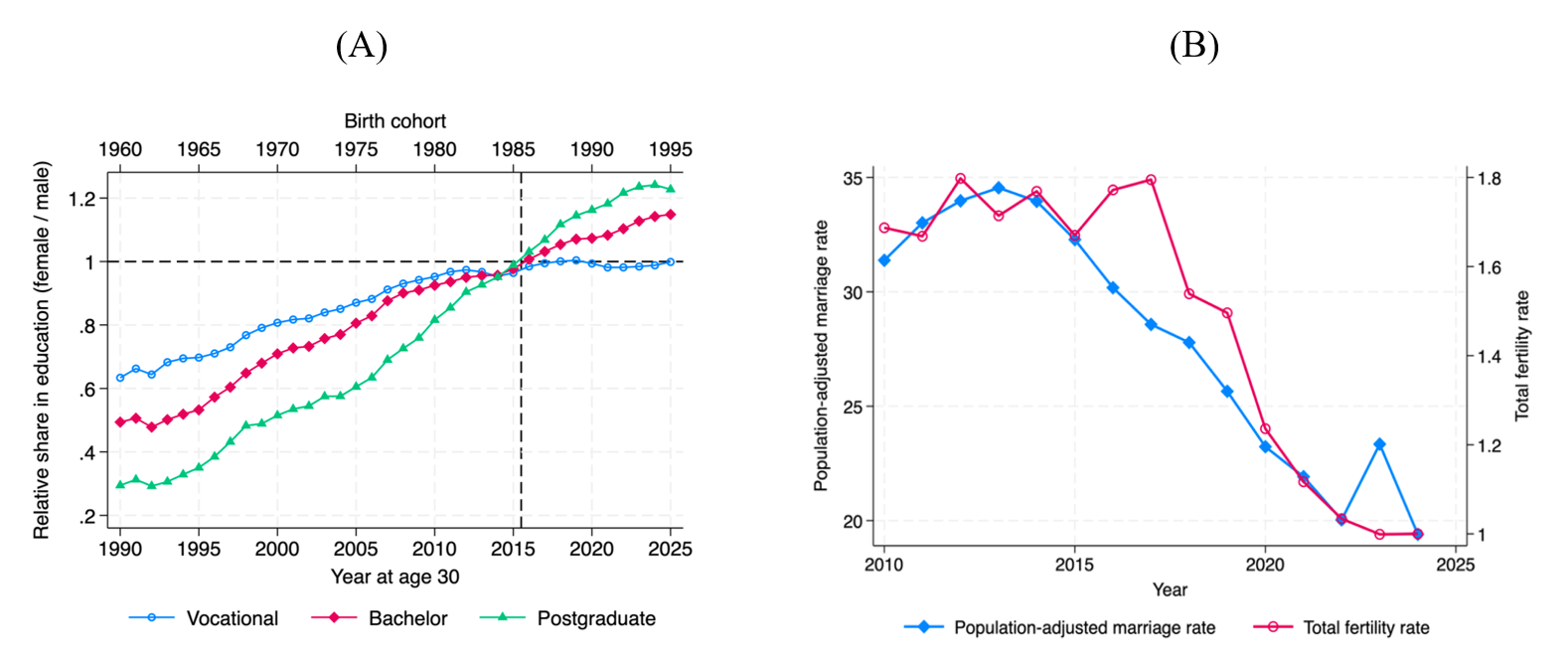
Notes: Panel (A) presents the female-to-male relative share in education by birth cohort, calculated from the 2020 census. A ratio of 1 means the number of females having the same degree equals that of males. The top x-axis marks the birth year, and the bottom x-axis shows the year they are 30, around the prime age of marriage. Panel (B) plots the population-adjusted marriage rate (number of new marriages per age 18–35 population, calculated from the China Statistical Yearbooks) and total fertility rate (data from the World Bank).
At the same time, China’s economic structure has shifted decisively toward the service sector, which is disproportionately concentrated in more developed cities. Highly educated women are especially likely to work in services (82% for college educated, 36% for non-college educated, according to the 2015 census), and therefore to migrate to developed urban areas.
The result is gender-specific spatial sorting:
• Highly educated women increasingly cluster in rich, service-oriented cities.
• Less educated men are overrepresented in less developed regions.
Marriage norms that didn’t move
If marriage norms adjusted smoothly to these changes, spatial sorting alone would not necessarily reduce marriage rates. But marriage norms have proven remarkably persistent.
Using census data, we document strong and stable hypergamy in China’s marriage market. Women are more likely to marry men with higher socioeconomic status, while men are more likely to marry women with lower status. These patterns hold across time, regions, and education groups.
Crucially, even as women’s education rises, married women remain less educated than unmarried women on average, while the opposite is true for men. This indicates that highly educated women face greater difficulty converting their economic success into marriage.
When combined with spatial sorting, these norms generate local imbalances: in large cities, the pool of “acceptable” male partners grows much more slowly than the number of highly educated women.
A spatial mismatch in singlehood
The interaction of demographic change and persistent norms produces a stark spatial pattern of singlehood.
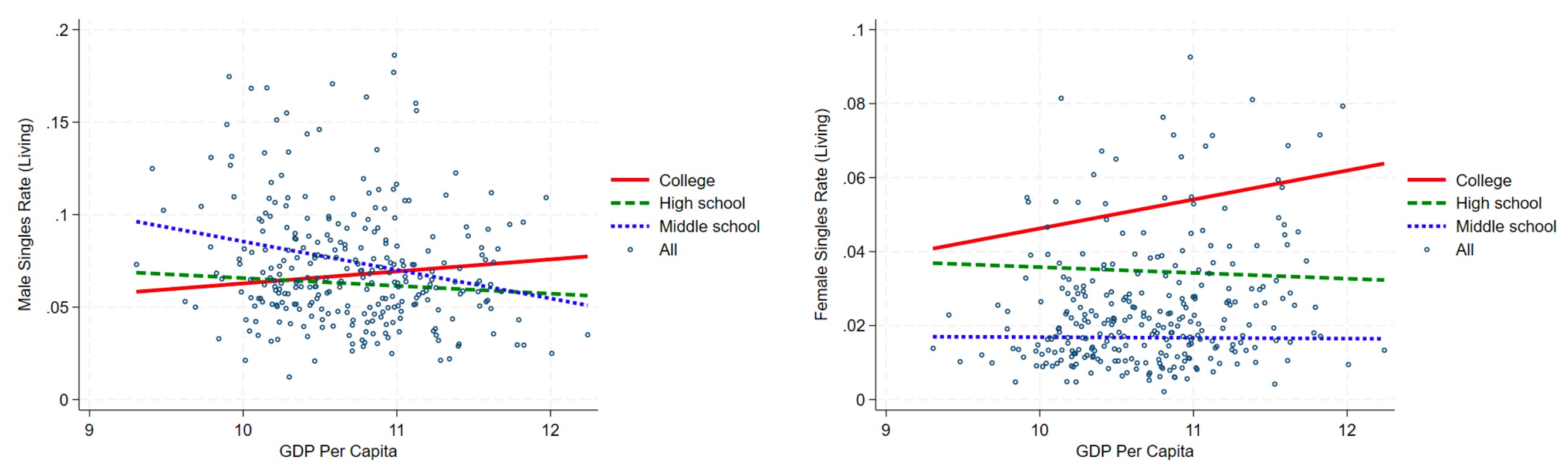
Figure 2 plots singles rates by gender and education levels against city development levels. In more developed cities, female singles rates—especially among college-educated women—are substantially higher. In less developed regions, male singles rates are higher, particularly among low-skilled men.
Figure 2. City-level GDP and Singles Rate of Age 30-45 in 2015
This pattern is not driven by changing preferences for marriage. Based on the China Family Panel Studies (CFPS) 2018 and 2020 surveys, the majority of single individuals reported that they still want to marry. The problem is not willingness to marry, but difficulty matching within local marriage markets.
Quantifying the role of spatial sorting
To understand how these local imbalances translate into national outcomes, we develop a prefecture-level spatial equilibrium model that links migration, sectoral employment, housing costs, and local marriage markets.
The model allows us to ask a counterfactual question: What would China’s marriage market look like without gender-specific spatial demographic change?
The answer is striking.
As shown in Table 1, removing gender differences in education and spatial sorting would:
• Reduce the national single rate among females by about 30%.
• Reduce single rates among college-educated women by more than 50%.
• Lower single rates most sharply in developed cities for women and in poorer regions for men.
Table 1. The Effects of Gender-specific Spatial Demographic Changes on Singles Rates
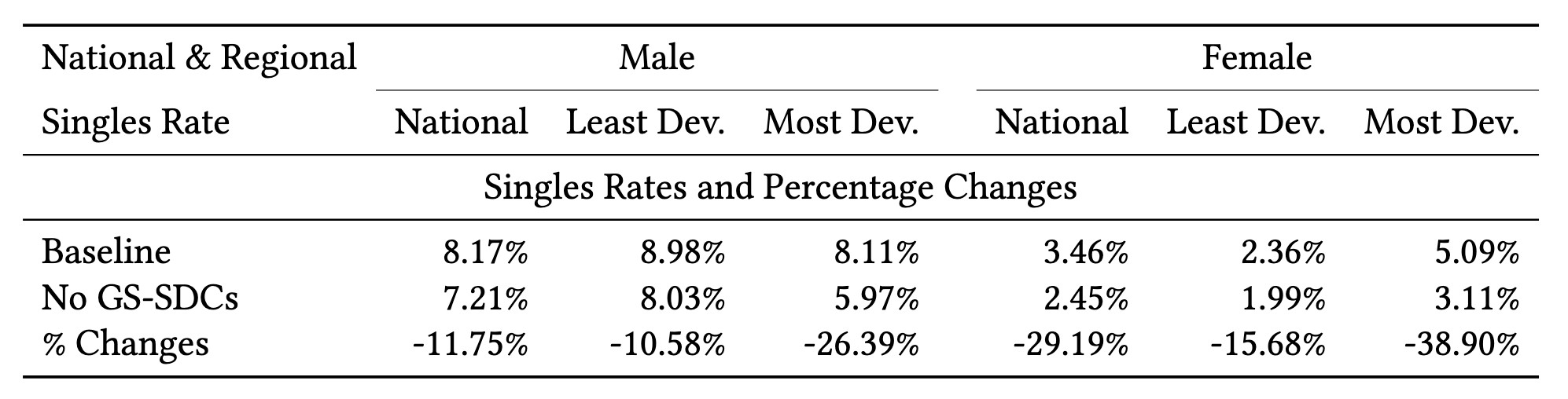
Decomposing these effects shows that roughly one-third comes from women’s educational gains relative to men, while about two-thirds comes from gender-specific sorting into service jobs and developed cities. By contrast, overall structural change from agriculture to non-agriculture plays a limited role.
Looking ahead, the problem may worsen
If current trends continue, the mismatch will likely intensify.
To show this, we project a counterfactual scenario for 2030 based on the 2015 equilibrium in our model and extrapolate the time trends observed from 2000 to 2015. Specifically, we make the following trend assumptions: (1) the female-to-male high-skill ratio increases from 1.15 in 2015 to 1.30 in 2030; (2) the female-to-male employment gap increases to 46.61% (+25.41 percentage points) for high-skill, 8.45% (+4.35 p.p.) for medium-skill, and 36.47% (+27.17 p.p.) for low-skill groups; and (3) doubling the existing gap in spatial allocation costs to top cities and bottom cities for females. With such a projection of 2030, we find that in Figure 3:
• The national female singles rate could rise by nearly 60%.
• Singles rates among highly educated women in top-tier cities could increase dramatically.
• Male singlehood would also rise, especially among low-skilled men in less developed regions.
Figure 3. How about the Future? China in 2030
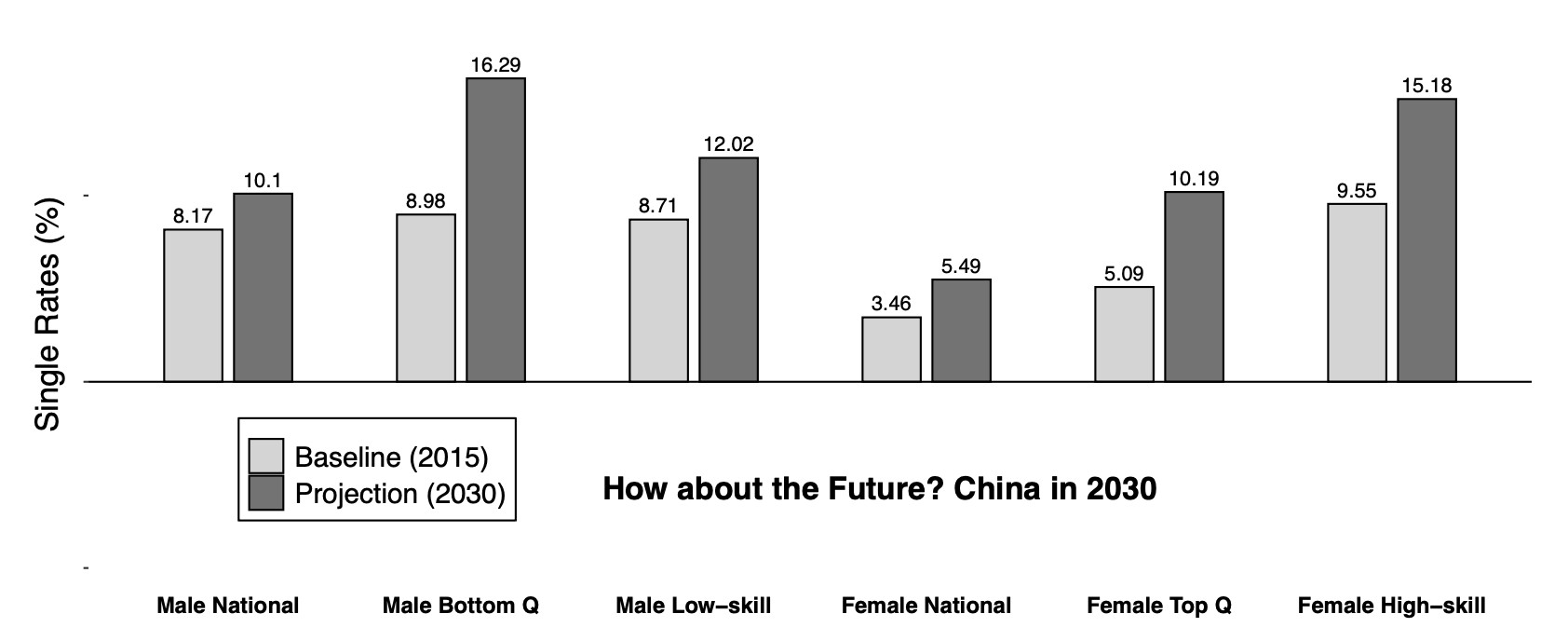
Notes: This figure plots the single rate for each gender under different scenarios. “Baseline (2015)” presents the equilibrium outcomes in the real world for 2015. “Projection (2030)” shows the counterfactual in which the gender-specificities in education, sectoral, and spatial-sectoral allocation costs are projected into 2030 based on the trends between 2000 and 2015. “Bottom Q” and “Top Q” represent prefecture quartiles by GDP per capita.
In short, without intervention, spatial mismatch in marriage markets is likely to become an even more important driver of China’s demographic challenges.
Why marriage subsidies fall short
Many governments, including China’s, have turned to financial incentives—such as housing subsidies or baby bonuses—to encourage family formation and fertility. We evaluate these policies by simulating large marriage subsidies in our model, in which marriage implicitly incorporates all benefits as a family, including children.
It shows that even subsidies equivalent to 10% of lifetime household income have surprisingly small effects. National single rates fall by less than one percentage point, with even smaller impacts for the groups most affected by spatial mismatch: highly educated women in developed cities and low-skilled men in poorer regions.
The reason is simple. Subsidies raise the value of marriage, but they do not fix the lack of suitable partners in local marriage markets. Many individuals remain single not because marriage is too costly, but because acceptable matches are scarce.
A broader lesson
China’s experience highlights a broader challenge facing many economies. When demographic change, spatial sorting, and social norms evolve at different speeds, mismatches can emerge with large aggregate consequences.
Declining marriage rates are not solely the result of changing preferences or rising living costs. They can arise from where people live, who they work with, and whom they are expected to marry.
Understanding these interactions is essential for designing policies that address the root causes of declining marriage and fertility rates—rather than treating their symptoms.
References
Edlund, L., “Sex and the City,” Scandinavian Journal of Economics 107 (2005), 25–44.
Edlund, L., H. Li, J. Yi, and J. Zhang, “Sex Ratios and Crime: Evidence from China,” Review of Economics and Statistics 95 (2013), 1520–1534.
Fang, M., Z. Huang, Y. Wang, and Y. Yang, “Sex and the City: Demographics, Spatial Sorting, and the Marriage Market,” Working paper (2026).
Feng, Y., J. Ren and M. Rendall, “The Reversal of the Gender Education Gap with Economic Development,” Working paper (2025).
Jin, X., L. Liu, Y. Li, M. W. Feldman, and S. Li, “"Bare Branches" and the Marriage Market in Rural China: Preliminary Evidence from a Village-Level Survey,” Chinese Sociological Review 46 (2013), 83–104.
Koh, Y., J. Li, Y. Wu, J. Yi, and H. Zhang, “Young Women in Cities: Urbanization and Gender-Biased Migration,” Journal of Development Economics 172 (2025), 103378.
Ong, D., Y. A. Yang, and J. Zhang, “Hard to Get: The Scarcity of Women and the Competition for High-Income Men in Urban China,” Journal of Development Economics 144 (2020), 102434.

Latest
Most Popular
- VoxChina Covid-19 Forum (Second Edition): China’s Post-Lockdown Economic Recovery VoxChina, Apr 18, 2020
- China’s Great Housing Boom Kaiji Chen, Yi Wen, Oct 11, 2017
- China’s Joint Venture Policy and the International Transfer of Technology Kun Jiang, Wolfgang Keller, Larry D. Qiu, William Ridley, Feb 06, 2019
- The Dark Side of the Chinese Fiscal Stimulus: Evidence from Local Government Debt Yi Huang, Marco Pagano, Ugo Panizza, Jun 28, 2017
- Wealth Redistribution in the Chinese Stock Market: the Role of Bubbles and Crashes Li An, Jiangze Bian, Dong Lou, Donghui Shi, Jul 01, 2020
- Evaluating Risk across Chinese Housing Markets Yongheng Deng, Joseph Gyourko, Jing Wu, Aug 02, 2017
- Daily Price Limits and the Magnet Effect Ting Chen, Zhenyu Gao, Jibao He, Wenxi Jiang, Wei Xiong, Oct 25, 2017
- What Is Special about China’s Housing Boom? Edward L. Glaeser, Wei Huang, Yueran Ma, Andrei Shleifer, Jun 20, 2017
- Privatization and Productivity in China Yuyu Chen, Mitsuru Igami, Masayuki Sawada, Mo Xiao, Jan 31, 2018
- How did China Move Up the Global Value Chains? Hiau Looi Kee, Heiwai Tang, Aug 30, 2017