
A Bridge on Economic Issues between China and the World



 Facebook
  Twitter
  Instagram
 WeChat
  Email
Email Laboratories of Autocracy: The Landscape of Central–Local Dynamics in China’s Policy Universe
China’s governance has long relied on local experimentation—cities and officials testing new ideas that sometimes spread nationwide. Using millions of policy documents from 2004 to 2020, this project maps how policies are born, travel, and scale across China’s political system. It shows how individual officials drive innovation, how competition shapes diffusion, and how a post-2013 turn toward central control has reduced local adaptation—often at a real economic cost.

China’s economic rise has long depended on local experimentation (Oi 1995, Montinola et al 1995, Xu 2011, Chen et al. 2024). From the household responsibility system that de-collectivized farming to free school meal programs, thousands of new policies were initiated locally, tested for their feasibility, before being promoted nationwide. In recent years, however, Beijing has tightened its grip over local decision-making, raising key questions: how much autonomy do localities still have, and does greater central control improve or hinder policy performance?
The impact of (de)centralization is usually studied by zooming in on a specific policy domain (for example, see Jia and Nie 2017, Lipscomb and Mobarak 2017, Wang and Wang 2020, Olken 2007). We contribute to the conversation by offering the first holistic account of the complete policy portfolios across various levels of government, thereby shedding light on not only policy enforcement, but also on policymaking itself.
As a starting point, in our recent working paper (Luo et al. 2025), we construct a comprehensive dataset of Chinese policies issued between 2004 and 2020, drawing on 3.7 million documents from the PKU Law database and prefectural work reports. We identify 115,679 unique keywords and trace each policy’s life cycle—its origin, diffusion, and potential adoption by the central government. Focusing on the industrial policy subsample, we link policies to economic outcomes such as output, exports, and patenting to study how centralization affects local adaptability and policy success.
The landscape of policymaking has been highly localized. We trace the life cycle of all policy initiatives between 2004 and 2020, paying special attention to the government body, central or local, that brings up those keywords for the very first time. In those years, roughly 80% of all new ideas originated at the local level, not in Beijing. Of those, about two-thirds spread to several other prefectures within three years, while a third remained isolated. Nearly a quarter eventually caught Beijing’s attention and were scaled up into national pilots or directives. Even when implementing central mandates, localities frequently rewrote them to suit local needs. Together, these patterns underscore China’s tradition of policymaking through local experimentation rather than strict top-down control.
Local bureaucrats play a central role, both on the innovation front and along the diffusion process. We start by asking whether policy innovation is primarily driven by innovative bureaucrats or if some localities inherently provide a more nurturing environment for innovation. To address this, we exploit the fact that local bureaucrats in China are frequently rotated across localities, and follow the approach described in Abowd et al. (1999) to separately identify bureaucrat fixed effects and locality fixed effects in driving policy innovations. We find that bureaucrat fixed effects explain five times more variation than locality fixed effects in the innovation index, which captures the average position in the sequence of adoption, weighted by policy importance.
To understand the key factors underpinning policy diffusion, we use an event-study design to compare prefectures before and after leadership turnover, and show that the adoption rate of a policy falls by about 40% immediately after the departure of the politician who created it (Figure 1). This suggests that officials, as if entrepreneurs, are actively promoting their own policy innovations to earn political credit. Along similar veins, we find that bureaucratic rivalry can suppress diffusion—cities led by competing cadres of similar ages, with similar educational background and job experiences, etc.—are less likely to learn from each other, meaning that many promising policies never spread. A telling example is Shanghai’s license plate auctions and Beijing’s choice of a lottery.
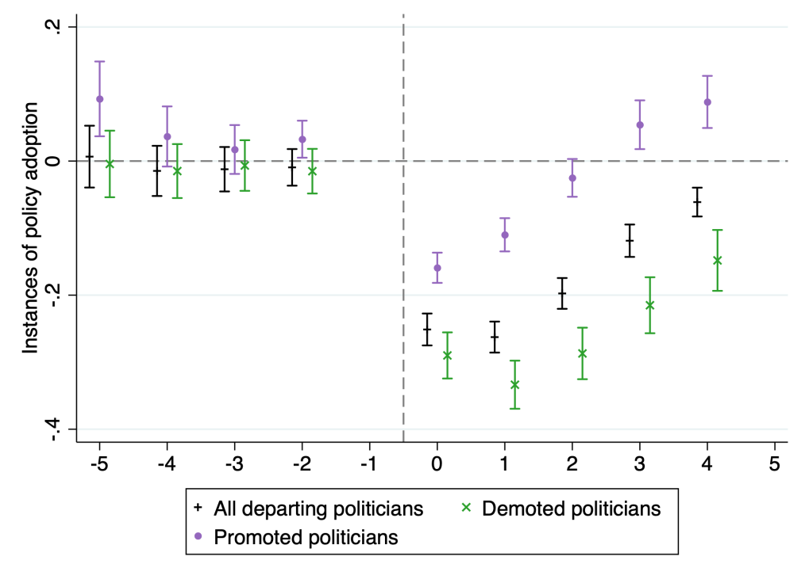
Figure 1: This figure presents event‐study estimates illustrating the decrease in policy adoptions after prefectural party‐secretary departure. Specifically, we run a policy-year level regression with two-way fixed effects, focusing on instances of adoption $\pm 5$ years around the departure of the politician who initiated the policy. We cluster standard errors at the policy level and compare baseline estimates with cases where the departing politicians got promoted or demoted.
The landscape has been shifting since 2013. Our data shows that policymaking became notably more centralized. The share of top-down policies in local portfolios rose by about 30%, and the average central directive spread to nearly three times as many prefectures as before. Meanwhile, the local tailoring also stagnated. Local governments also became twice as likely to replicate central directives verbatim rather than adapting them.
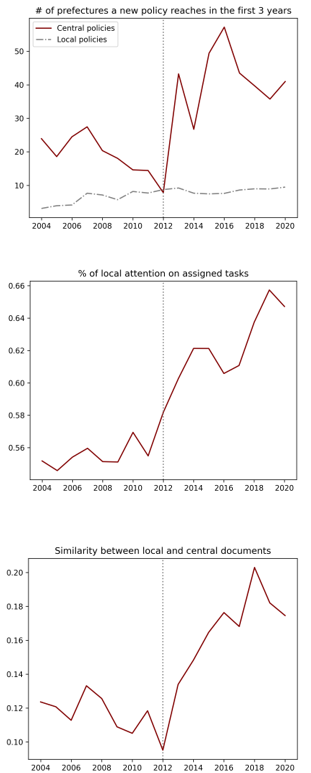
Figure 2: This figure illustrates the increasing centralization of policymaking after 2013. In panel A, we focus on central-government initiated policies, and plot the number of prefectures adopting the policy in the first three years by year of policy initiation. Panel B shows the annual trend in local governments' attention to centrally assigned tasks. For each locality-year, we calculate the share of implemented policies promoted by the central government beforehand, and then average this measure across all localities within the same year. In panel C, we compute the average textual similarity between the first central document on a certain topic and local follow-ups with TF-IDF algorithm, cosine similarity, and standard stop-word removal.
The shift toward centralization is partially underpinned by a reorientation of bureaucratic incentives. Before 2013, a standard deviation of local innovation raised an official’s promotion prospects by about 8%. Afterward, that advantage disappeared; instead, rapid and thorough compliance with central orders increased promotion odds by a similar margin. In areas overseen by new Central Leading Groups, local experimentation declined sharply while conformity surged.
The economic consequence of centralization is ex ante unclear. Centralization mitigates the friction created by political competition to learn horizontally, but it also creates incentives for compliance to blind adoption of otherwise unsuitable policies. We quantify both forces in our data, and find that top-down industrial policies are 18–22% less well matched to regional industrial structures and private investment patterns. For example, central mandates for wind farms in low-wind provinces created “ghost” facilities that are economically unsustainable. The “mis-allocation” of policies translates directly into the ineffectiveness of industrial policies. We quantify this by estimating a triple-difference regression where the parameter of interest is the marginal treatment effect of industrial policies adoption interacted with its suitability with local endowments. All prefecture–year shocks that might drive policy adoption—such as local downturns, leadership changes, or political pressure—are absorbed by prefecture-by-year fixed effects. What identifies the coefficient is whether, holding the timing of adoption fixed, policies work better in industries that were ex ante well matched to local endowments than in those that were not.
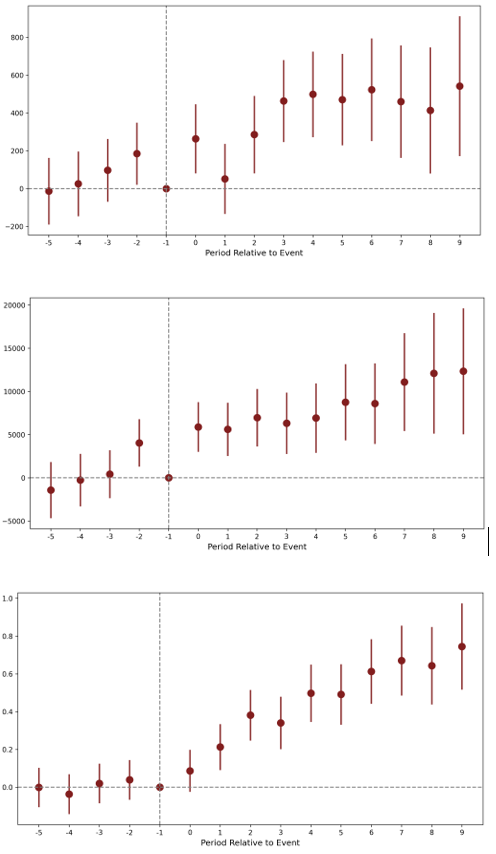
Figure 3: This figure illustrates how policy effectiveness varies with \textit{ex ante} local suitability, based on a triple-difference strategy. We define the treatment as the implementation of any industrial policy in prefecture $p$ during year $t$ targeting industry $i$. We include dummy variables for five lead periods and 10 lag periods relative to that treatment, as well as their interactions with policy-locality suitability (constructed using supply-chain). We report the estimated coefficients and standard errors before the interaction term. Prefecture-by-year, prefecture-by-industry, and industry-by-year fixed effects are controlled in each regression. Standard errors are clustered at the prefecture level.
The economic cost of centralization is huge. Its economic costs outweigh its benefits by more than four to one. The resulting mismatch costs an estimated ¥400 billion in lost output, ¥32 billion in exports, and around 750 fewer patents annually.
Taken together, the findings suggest that while China’s development model long relied on decentralized experimentation, post-2013 centralization has shifted the balance toward compliance and control. This may serve strategic or political goals, but it weakens local adaptability and reduces overall policy effectiveness—signaling that China is trading some of its growth and innovation dynamism for tighter political discipline.
The trade-offs studied in this paper are not unique to China. As governments around the world grapple with challenges that demand both coordination and customization—from climate mitigation, to education policy, to industrial strategy—understanding the optimal hierarchical level for decision-making and the associated trade-offs becomes increasingly imperative. By illuminating the mechanisms and consequences of centralization in China’s policymaking, this paper provides new evidence and calls for a reconsideration of how polities of varying sizes can design institutions that balance local initiative with system-wide integration.
References
Abowd, John M., Francis Kramarz, and David N. Margolis. 1999. “High wage workers and high wage firms.” Econometrica 67 (2): 251–333. https://doi.org/10.1111/1468-0262.00020.
Chen, Heng, Bingjing Li, and Xiaodong Zhu. 2024. “Bottom-Up Institutional Change and Growth in China.” Asian Bureau of Finance and Economic Research. https://abfer.org/media/abfer-events-2025/annual-conference/papers-trade/AC25P4017_Bottom-Up-Institutional-Change-and-Growth-in-China.pdf.
Jia, Ruixue, and Huihua Nie. 2017. “Decentralization, Collusion, and Coal Mine Deaths.” Review of Economics and Statistics 99 (1): 105–18. https://doi.org/10.1162/REST_a_00563.
Lipscomb, Molly, and Ahmed Mushfiq Mobarak. 2017. “Decentralization and Pollution Spillovers: Evidence from the Re-drawing of County Borders in Brazil.” Review of Economic Studies 84 (1): 464–502. https://doi.org/10.1093/restud/rdw023.
Luo, Kaicheng, Shaoda Wang, and David Y. Yang. 2025. “Laboratories of Autocracy: Landscape of Central–Local Dynamics in China’s Policy Universe.” National Bureau of Economic Research Working Paper No. 34219. https://www.nber.org/papers/w34219.
Montinola, Gabriella, Yingyi Qian, and Barry R. Weingast. 1995. “Federalism, Chinese Style: The Political Basis for Economic Success in China.” World Politics 48 (1): 50–81. https://doi.org/10.1353/wp.1995.0003.
Oi, Jean C. 1995. “The Role of the Local State in China’s Transitional Economy.” China Quarterly 144: 1132–49. https://doi.org/10.1017/S0305741000004768.
Olken, Benjamin A. 2007. “Monitoring Corruption: Evidence from a Field Experiment in Indonesia.” Journal of Political Economy 115 (2): 200–24. https://doi.org/10.1086/517935.
Wang, Shaoda, and Zenan Wang. 2020. “The Environmental and Economic Consequences of Internalizing Border Spillovers.” University of Chicago: Energy Policy Institute. https://epic.uchicago.edu/events/event/the-environmental-and-economic-consequences-of-internalizing-border-spillovers/.
Xu, Chenggang. 2011. “The Fundamental Institutions of China’s Reforms and Development.” Journal of Economic Literature 49 (4): 1076–1151. https://doi.org/10.1257/jel.49.4.1076.

Latest
Most Popular
- VoxChina Covid-19 Forum (Second Edition): China’s Post-Lockdown Economic Recovery VoxChina, Apr 18, 2020
- China’s Great Housing Boom Kaiji Chen, Yi Wen, Oct 11, 2017
- China’s Joint Venture Policy and the International Transfer of Technology Kun Jiang, Wolfgang Keller, Larry D. Qiu, William Ridley, Feb 06, 2019
- The Dark Side of the Chinese Fiscal Stimulus: Evidence from Local Government Debt Yi Huang, Marco Pagano, Ugo Panizza, Jun 28, 2017
- Wealth Redistribution in the Chinese Stock Market: the Role of Bubbles and Crashes Li An, Jiangze Bian, Dong Lou, Donghui Shi, Jul 01, 2020
- Evaluating Risk across Chinese Housing Markets Yongheng Deng, Joseph Gyourko, Jing Wu, Aug 02, 2017
- Daily Price Limits and the Magnet Effect Ting Chen, Zhenyu Gao, Jibao He, Wenxi Jiang, Wei Xiong, Oct 25, 2017
- What Is Special about China’s Housing Boom? Edward L. Glaeser, Wei Huang, Yueran Ma, Andrei Shleifer, Jun 20, 2017
- Privatization and Productivity in China Yuyu Chen, Mitsuru Igami, Masayuki Sawada, Mo Xiao, Jan 31, 2018
- How did China Move Up the Global Value Chains? Hiau Looi Kee, Heiwai Tang, Aug 30, 2017